

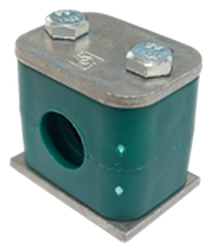


Two-piece clamps that hold tube, pipe, hose and cable steady — and take the vibration that flowing fluid creates out of the run before it reaches a fitting or weld. Remove two bolts and the line lifts out.
State the line OD, series, body material and hardware (W) code — quotes back within 2 working hours.
| Standard | DIN 3015 parts 1, 2 & 3 — interchangeable across batches & suppliers |
|---|---|
| Series | Standard · Heavy · Twin (2 lines per clamp) |
| Range | 6 – 406 mm (to 16″) |
| Body | PP green · PA black · aluminium silver · PP + rubber insert |
| Hardware | W1–W5 — carbon steel through A4 stainless (316/316Ti) |
| Mounting | Weld plate · mounting rail · stacking |
Full dimension tables per group are in the catalogue below, as printed — the load, torque & spacing tables are on this page.
| At a glance | Standard | Heavy | Twin |
|---|---|---|---|
| Range | 6–102 mm | 6–406 mm | 6–42 mm ×2 |
| Max load (PP) | 2.6 kN | 168 kN | 2.7 kN |
| Used in | Mobile & machine tools | Metal & mining | Closely placed lines |
Two body halves close around the line, held by a cover plate and bolts, sitting on a base plate welded or bolted to structure. The job goes beyond support: the clamp absorbs the impact and vibration of flowing fluid before joints work loose.
Clamps, base plates, mounting rails and accessories are one system — all to DIN 3015, so parts from different batches and suppliers stay interchangeable. Used on pulsating hydraulic runs, mobile equipment, mining, and marine & offshore installations.
| Series | Range | Application | Load level |
|---|---|---|---|
| Standard | 6–102 mm (to 4″) | Mobile equipment, machine tools | Average load, moderate vibration |
| Heavy | 6–406 mm (to 16″) | Metal manufacturing, mining | Higher load, higher vibration |
| Twin | 6–42 mm, 2 lines per clamp | General industrial, closely placed lines | Moderate vibration |
The series overlap at smaller sizes — at identical nominal dimensions they are different parts with different load capacities. Specify the duty, not just the dimension.
Maximum load by group kN · as printed
| Group | Polypropylene | Polyamide | Aluminium |
|---|---|---|---|
| 1 | 0.6 | 0.6 | 3.5 |
| 1A | 1.1 | 0.7 | 4.2 |
| 2 | 1.3 | 0.8 | 4.3 |
| 3 | 1.4 | 1.6 | 4.9 |
| 4 | 1.5 | 1.7 | 5.0 |
| 5 | 1.9 | 2.0 | 7.3 |
| 6 | 2.0 | 2.5 | 8.9 |
| 7 | 2.3 | 3.2 | — |
| 8 | 2.6 | 3.5 | — |
| 1D twin | 0.9 | 0.9 | — |
| 2D twin | 2.1 | 2.2 | — |
| 3D twin | 1.9 | 2.0 | — |
| 4D twin | 2.7 | 2.9 | — |
| 5D twin | 1.7 | 2.5 | — |
Heavy series kN · as printed
| Group | Polypropylene | Polyamide | Aluminium |
|---|---|---|---|
| 3S | 1.6 | 4.2 | 12.1 |
| 4S | 2.9 | 4.5 | 15.1 |
| 5S | 3.3 | 5.1 | 15.5 |
| 6S | 8.2 | 9.3 | 29.5 |
| 7S | 11.0 | 15.8 | 34.9 |
| 8S | 14.0 | 21.0 | 50.0 |
| 9S | 28.0 | 32.0 | 70.6 |
| 10S | 40.0 | 48.0 | 84.5 |
| 11S | 119.0 | 125.0 | 181.5 |
| 12S | 168.0 | 180.0 | 244.5 |
If load is the constraint, changing body material is often cheaper than changing series — at group 1, aluminium carries 3.5 kN against polypropylene’s 0.6 kN. Polyamide overtakes polypropylene from group 3 upward. Aluminium is not offered in standard groups 7–8 or the twin series.
| Code | Material | Finish |
|---|---|---|
| W1 | Carbon steel ST37.4 | Untreated |
| W2 | Carbon steel ST37.4 | Phosphated |
| W3 | Carbon steel ST37.4 | Zinc/nickel plated |
| W4 | Stainless A2 | 1.4301/1.4305 (AISI 304/303) |
| W5 | Stainless A4 | 1.4401/1.4571 (AISI 316/316Ti) — marine, offshore, washdown |
| W10 | Carbon steel ST37.4 | Weld plate phosphated; other parts zinc/nickel coated |
| W11 | Carbon steel ST37.4 | Rail nut untreated so it keeps sliding in the rail; other parts coated |
W5 is not a luxury option: in salt conditions, W4 (AISI 304) does not perform like W5 (AISI 316/316Ti). W10 and W11 are deliberate mixtures — zinc burns off a weld plate during welding, and a coated rail nut stops sliding in the rail.
Tightening torque Nm · by series & body material
| Series / group | Polypropylene | Polyamide | Aluminium |
|---|---|---|---|
| Standard 1–6 | 8 | 10 | 12 |
| Standard 7–8 | 8 | 10 | — |
| Twin 1D | 5 | 5 | — |
| Twin 2D–4D | 12 | 12 | — |
| Twin 5D | 8 | 8 | — |
| Heavy 3S–4S | 12 | 20 | 30 |
| Heavy 5S | 15 | 25 | 35 |
| Heavy 6S | 30 | 40 | 55 |
| Heavy 7S | 45 | 55 | 120 |
| Heavy 8S | 80 | 150 | 220 |
| Heavy 9S | 110 | 200 | 250 |
| Heavy 10S | 180 | 350 | 500 |
| Heavy 11S | 200 | 370 | 500 |
| Heavy 12S | 270 | 450 | 600 |
Pre-tighten every bolt by hand before final torque. Under-torqued bolts let the body deform without developing clamping force; over-torqued bolts break the body during installation.
Maximum distance between clamps by pipe OD
| Pipe OD range | Max spacing |
|---|---|
| 6.0 – 12.7 mm | 1.0 m |
| 12.7 – 22.0 mm | 1.2 m |
| 22.0 – 32.0 mm | 1.5 m |
| 32.0 – 38.0 mm | 2.0 m |
| 38.0 – 57.0 mm | 2.7 m |
| 57.0 – 75.0 mm | 3.0 m |
| 75.0 – 76.1 mm | 3.5 m |
| 76.1 – 88.9 mm | 3.7 m |
| 88.9 – 102.0 mm | 4.0 m |
| 102.0 – 114.0 mm | 4.5 m |
| 114.0 – 168.0 mm | 5.0 m |
| 168.0 – 219.0 mm | 6.0 m |
| 219.0 – 324.0 mm | 6.7 m |
| 324.0 – 356.0 mm | 7.0 m |
| 356.0 – 406.0 mm | 7.5 m |
Those are maximum distances — place clamps closer at bends, valves, pumps and changes of direction.
Weld the base plate to structure, or use the elongated two-hole plate with no welding. Lower half onto the plate, lay in the line, close with the upper half and cover plate. Threads in metric (M) or UNC (U).
Weld the rail once for multiple clamps. Rail nuts drop into the channel and rotate to lock — clamps can be added, removed or repositioned without touching the structure again.
Identical bodies mount on top of each other with stacking bolts and safety locking plates; the plate between levels stops the bolts rotating. The top level finishes with a cover plate.
Complete-set part codes PP body examples · same pattern for PA & AL
| Part code | Contents |
|---|---|
| SP-PP-DP-AS | Single weld plate + PP clamp + cover plate + hexagon bolts (×2) |
| SP-PP-IS | Single weld plate + PP clamp + Allen cap screws (×2) |
| SPV-PP-DP-AS | Elongated weld plate + PP clamp + cover plate + hexagon bolts (×2) |
| SPV-PP-IS | Elongated weld plate + PP clamp + Allen cap screws (×2) |
| SM-PP-DP-AS | Hexagon rail nuts (×2) + PP clamp + cover plate + hexagon bolts (×2) |
| SM-PP-IS | Hexagon rail nuts (×2) + PP clamp + Allen cap screws (×2) |
| PP-DP-AS | PP clamp + cover plate + hexagon bolts (×2) — no mounting plate |
| PP-IS | PP clamp + Allen cap screws (×2) — no mounting plate |
| PP-SIG-AF | PP clamp + locking plate + stacking bolts (×2) — for stacking |
Reading the code: SP = single weld plate · SPV = elongated plate · SM = rail nuts · no prefix = no mounting part. AS = cover plate with hexagon bolts; IS = Allen cap screws without cover (lower profile); SIG-AF = the stacking set.
System accessories available from the same stock: base weld plate · top plate · double top plate · safety locking plate · hexagon rail nut · group weld plate · elongated base plate · channel rail adaptor · mounting rail · stacking bolt · double base plate — in stainless SS316 or galvanized steel.


Dimensions and part numbers are in the catalogues, as printed; stock and price are not — send the list and we confirm both. More in the catalogue library.
Holding a tube, pipe, hose or cable in place — and critically, absorbing the impact and vibration that flowing fluid creates before it reaches a fitting or weld. Unclamped runs work their own joints loose over time; the clamp grips the line over a broad contact area without deforming the tube.
By pipe OD: a 6–12.7 mm line takes a clamp every 1 m; 22–32 mm every 1.5 m; 88.9–102 mm every 4 m; 356–406 mm every 7.5 m. Those are maximums — go closer at bends, valves and pumps. The full table is above.
Load and vibration decide, not size alone. Standard (6–102 mm) for average load in mobile equipment and machine tools; heavy (6–406 mm) for higher load and vibration in metal plants and mining; twin (6–42 mm) for two closely placed lines. The series overlap at smaller sizes — specify the duty.
The body material = the temperature rating. Green polypropylene −30…+90 °C; black polyamide −40…+120 °C; silver aluminium up to +300 °C. A fourth option: PP with a rubber insert where a softer grip is needed.
The hardware finish code: W5 = A4 stainless (1.4401/1.4571, AISI 316/316Ti) for marine, offshore and washdown. Do not accept W4 (AISI 304) as equivalent in salt conditions. W1 untreated · W2 phosphated · W3 zinc/nickel plated.
Because each part has a different job: W10 leaves the weld plate phosphated (zinc burns off during welding anyway) while coating the rest; W11 leaves the rail nut untreated so it keeps sliding and locking in the rail. Both are deliberate specifications.
To the torque table for the series, group and body material — standard 8/10/12 Nm; heavy up to 270/450/600 Nm at 12S. Pre-tighten every bolt by hand first, then final torque. Under-torqued = body deforms; over-torqued = body breaks.
Aluminium, by far — 3.5 kN against polypropylene’s 0.6 kN at group 1. Polyamide overtakes polypropylene from group 3 upward. If load is the constraint, changing material is often cheaper than changing series. Note: no aluminium in standard groups 7–8 or the twin series.
Yes — especially on a mounting rail: weld the rail once, then add, remove or reposition clamps anywhere along it with rail nuts, without touching the structure. Base-plate installs need a new plate welded per added clamp.
Yes — identical bodies stack with stacking bolts + safety locking plates (set code SIG-AF). The locking plate between levels stops the bolts rotating; the top level takes a cover plate. Works on base plates and rails alike.
Outside diameter, always. The clamp closes around the outside of the line. A “1 inch pipe” is 33.7 mm outside, not 25.4 — and takes the 33.7 clamp. This is the most common ordering error.
Yes — held in our regional warehouses in Singapore and Malaysia, out within 24 hours of your PO. Aluminium bodies, SS316 hardware and custom accessories come to order with lead times in the quotation. Quotes within 2 working hours.
Related: Tubeclo DIN 3015 clamps · ACT anti-corrosion clamps · rubber insert clamps · all pipe clamps · about the STAUFF brand · baca halaman ini dalam Bahasa Indonesia