

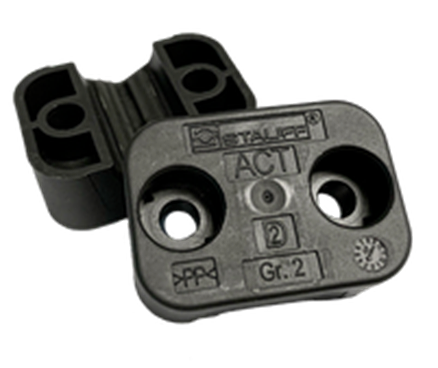


A DIN 3015 clamp redesigned around one core problem: the clamp is often what corrodes the tube. Flame-retardant PPV0 body with a lobed bore, integrated anti-corrosion elastomer strips and drainage channels — so water drains away instead of stagnating.
State the tube OD, series (standard/twin) and configuration — quotes back within 2 working hours.
| Range | 6 – 25.4 mm (1/4″ – 1″) · other sizes on request |
|---|---|
| Series | Standard & twin — no heavy series |
| Body | Flame-retardant PPV0, tested V0 to UL94 |
| Temperature | −25 °C to +80 °C continuous |
| Hardware | V4A / W55 stainless, impurities excluded in production |
| Standards | NORSOK Z-010 · API RP 552 · NACE SP0108-2008 · DIN 3015 |
Full dimensions and component codes are in the catalogue below, as printed.
| At a glance | How ACT prevents corrosion |
|---|---|
| Problem | Pitting (seawater chlorides + heat) & crevice corrosion (water trapped under the clamp) |
| Solution | Lobed bore — tube rests on rib crowns · elastomer strips · open drainage channels |
| Used on | Subsea · topside · rigs — stainless instrumentation & hydraulic lines |
Under specific conditions — particularly chlorides such as the sodium chloride in seawater, made worse by elevated temperature — small pits form in the stainless surface. Once started, pits grow below the surface.
Created by the clamp itself trapping water. Clamps made of PVC plastic have been particularly prone to it — the plastic deforms around the tubing and tightens the crevice. ACT breaks the mechanism: the tube rests on the rib crowns of a lobed bore, with open drainage channels so water never stagnates.
| Configuration | Standard series | Twin series |
|---|---|---|
| Welded, bolted cover | Weld plate SP + cover DP + hex bolts AS | Weld plate SP + cover GD + hex bolts AS |
| Hammerhead bolt | Cover DP + hammerhead HKS + self-locking MUS-HKS | Cover GD + hammerhead HKS + self-locking MUS-HKS |
| Stacked | Safety locking plate SIG + stacking bolts AF | Safety locking plate SIG + stacking bolts AF |
Standards compliance
| Standard | Purpose |
|---|---|
| NORSOK Z-010 | Norwegian offshore standard |
| API RP 552 | American Petroleum Institute recommended practice |
| NACE SP 0108-2008 | Corrosion control norms |
| UL 94 | Flammability classification — body tested V0 |
| DIN 3015 | Clamp geometry — compatible with the ordinary STAUFF system |
Mark the weld plate alignment on the structure, then weld or bolt it down.
Push the bottom clamp half onto its base plate.
The tube rests on the rib crowns of the lobed bore — the drainage channels stay open.
Top half + cover plate, bolted. For closely spaced lines, stack with SIG + AF.
Recommended clamp spacing by pipe OD · as printed
| Pipe OD range | Spacing |
|---|---|
| 6.0 – 12.7 mm | 1.0 m |
| 12.7 – 22.0 mm | 1.2 m |
| 22.0 – 32.0 mm | 1.5 m |
| 32.0 – 38.0 mm | 2.0 m |
| 38.0 – 42.0 mm | 2.7 m |
Maintenance that extends the life: clean off dirt after use, store spare stock somewhere dry, and keep it away from standing water, oil and grease — for underwater installations, make sure every material in the assembly is anti-corrosive. STAUFF itself (Walter Stauffenberg GmbH & Co. KG, Werdohl, Germany — established in the 1950s) developed the ACT line specifically for these environments.


Dimensions and component codes are in the catalogues, as printed; stock and price are not — send the list and we confirm both.
Anti-Corrosion Technology — a STAUFF clamp built to DIN 3015 and redesigned so the clamp does not become the place where a stainless tube starts to corrode. Also called anti-crevice tubing supports.
Because it deforms around the tubing and creates an even tighter crevice. STAUFF is direct about it: clamps made of PVC plastic have been particularly prone to producing crevice corrosion.
Two things: they stop seawater accumulating between clamp and pipe, and they create drainage channels that let water disperse rather than stagnate. They are moulded into the body, not a separate insert.
−25 °C to +80 °C continuous — narrower than ordinary clamps (PP +90 °C, PA +120 °C). Outside that range, see the standard STAUFF clamps.
V4A / W55. What matters is not just the alloy designation — the corrosion resistance is enhanced by practically excluding metallic and non-metallic impurities during production, processing and handling.
No — ACT is standard and twin only, 6–25.4 mm. A deliberate limit: that range covers the tube sizes that actually suffer pitting and crevice corrosion on offshore installations.
Yes — using the safety locking plate (SIG) + stacking bolts (AF), identically sized bodies mount directly on top of one another.
Yes — held in our regional warehouses in Singapore and Malaysia, out within 24 hours of your PO; quotes within 2 working hours. Sizes outside the standard range come on request.
Related: STAUFF DIN 3015 clamps · Tubeclo clamps · rubber insert clamps · the stainless tube it clamps · all pipe clamps · baca halaman ini dalam Bahasa Indonesia