A quarter-turn shutoff that is short, light and cheap at large bore. A CF8 disc rotates inside an EPDM liner, and the liner is what seals — the seat is the pressure boundary, not the body. Four variants: a wafer or lug body, in cast iron or ductile iron.
DN40 to DN150, seven sizes across all four variants. The ductile iron ones we stock in 2″–4″.
Per the catalogue features box. The test table gives a nominal 1.0 or 1.6 MPa depending on the variant — both are published.
The limit of the EPDM seat and the NBR O-ring, not of the iron. The castings go well beyond it; the rubber does not.
A lever with a notched locking plate, and a top flange that takes a gearbox or actuator — the same size on all four.
Send the size, the body style and the fluid — the seat governs, and quotes go out within 2 working hours.
Each has its own page with the full parts list, the dimension table and the sectional drawing.
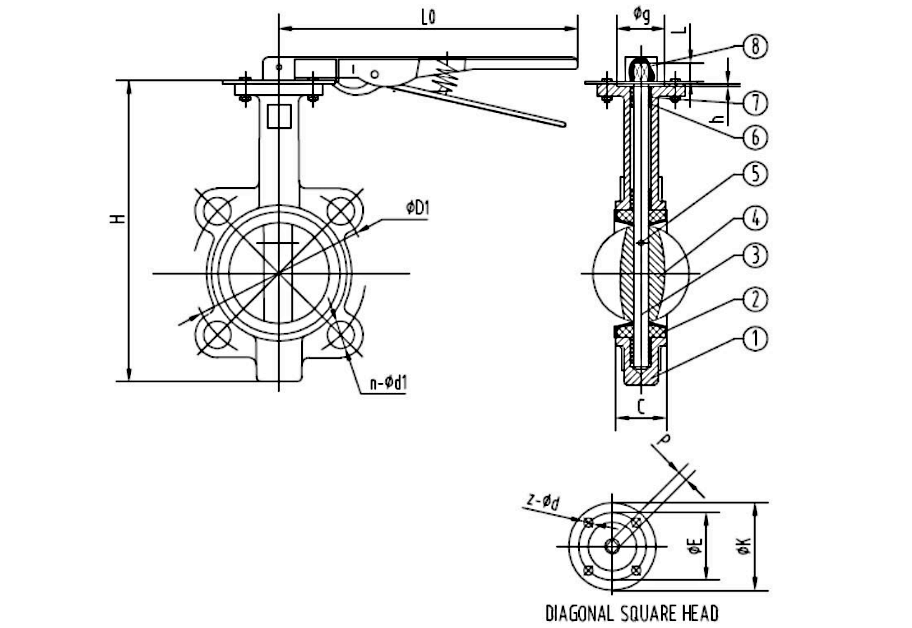
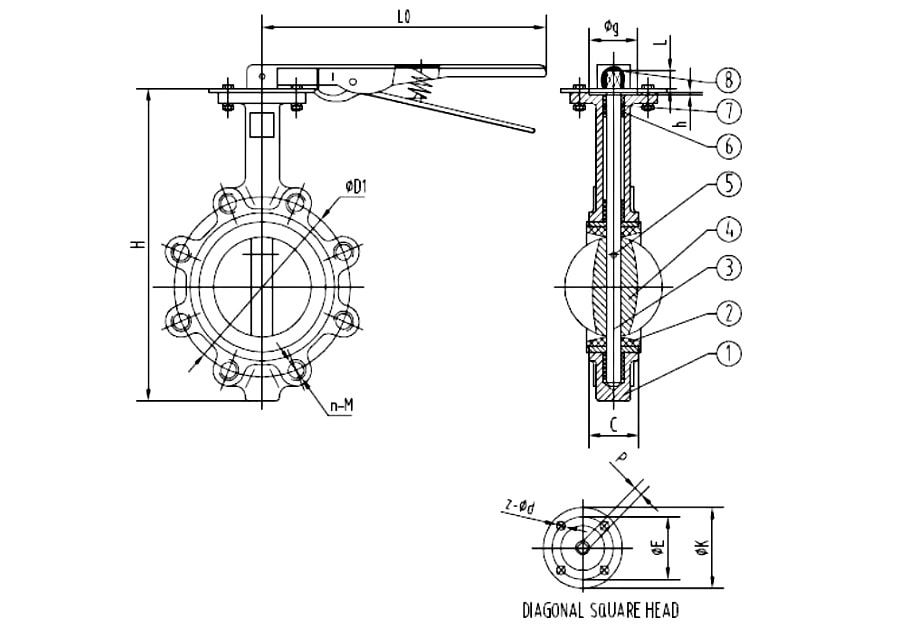
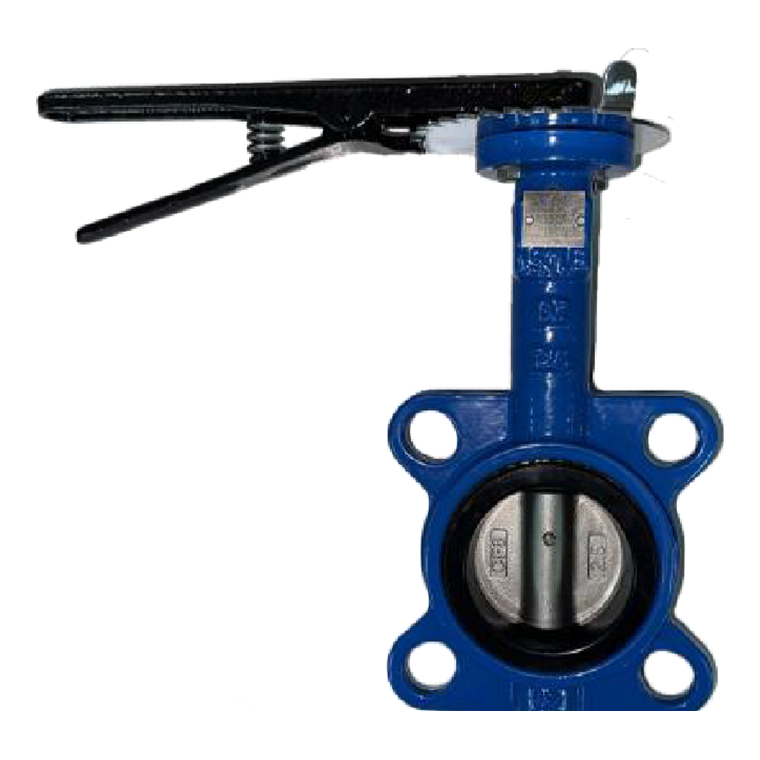
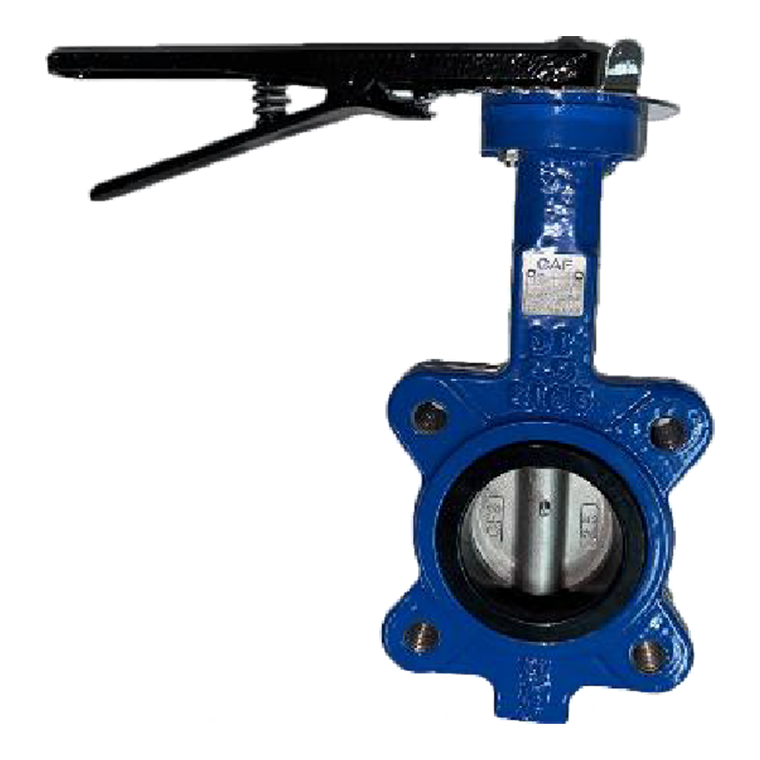
A quarter turn. The disc rotates in the flow; it never leaves it.
A round disc on a shaft across the bore. A quarter turn on the lever takes the disc from parallel with the flow to square across it, pressing its rim into the EPDM liner that lines the bore. That liner is what seals — the iron body is never a sealing surface.
Because the disc stays in the flow even when fully open, a butterfly valve always restricts a little — unlike a gate valve, which gives a straight bore. In exchange it is far shorter, far lighter and far cheaper at large bore, and it works in a quarter turn.
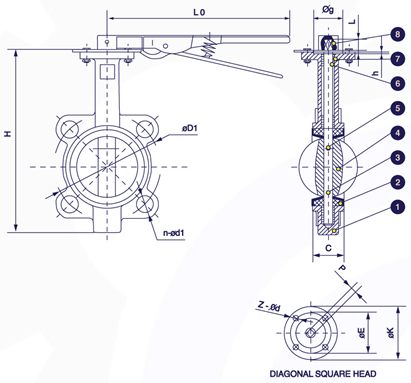
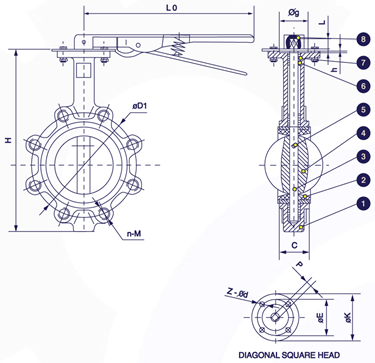
The EPDM liner seals the disc and, on a wafer body, seals against both pipe flanges too. That is why fluid compatibility is decided by the rubber, not the iron.
A wafer body is clamped between two flanges; a lug body has tapped holes and can sit at the end of a line. The internals are identical — one parts list covers both.
Most of the flow change happens in the last 30 degrees of the stroke. The notched plate allows a part-open setting, but for real regulation use a globe valve.
The C column in the dimension table is that protrusion. On the smaller sizes the disc comes out past the body face — a valve that fits in the run can still fail to open.
A lever is fine to about 4″; above that a gearbox is the right answer, and the top flange is already there for it.
A cast iron or ductile iron body with a CF8 (cast 304) disc. The disc is the only stainless part in the flow path — and 304 resists chlorides less well than 316.
The internals are identical. What differs is how it bolts into the line.
The most important thing on this page. Read it before you order.
This valve contains two different elastomers. The seat liner is EPDM — the part that seals the disc and, on a wafer body, seals against both pipe flanges. The shaft O-ring is NBR (nitrile) — the part that stops the fluid getting out along the shaft. Both are in contact with whatever is in the line, and their compatibility is close to opposite.
| Fluid | EPDM seat | NBR O-ring | Verdict for this valve |
|---|---|---|---|
| Water, cold or warm | Good | Good | Yes. This is the duty the valve is built for. |
| Hot water and low-pressure steam | Good — EPDM is at its best here | Poor — nitrile hardens and cracks | ⚠ Ask us. The seat is happy; the shaft seal is not. The published ceiling is 120 °C either way. |
| Mineral oil, hydraulic oil, diesel | Poor — EPDM swells badly in petroleum oils | Good — this is what nitrile is for | ⚠ No. The seat is the pressure boundary, and oil will destroy it. Use a ball valve. |
| Air and inert gas | Good | Good | Yes, within the temperature limits. |
| Glycol and water treatment chemicals | Generally good | Varies | Ask us with the exact chemical and concentration. |
| Anything aggressive or unusual | Depends entirely on the chemical | Depends entirely on the chemical | Send the fluid, the concentration and the temperature. We will check both elastomers, not one. |
Cold water, warm water, air. That is where an EPDM seat and an NBR O-ring both work, and it covers most of what a 1½″ to 6″ butterfly valve is used for — HVAC, cooling circuits, tank isolation, general service.
EPDM in mineral oil swells, softens and loses its shape — and on this valve the seat is the seal; there is no metal seat behind it to fall back on. For oil, use a ball valve or a gate valve.
Cast iron and a CF8 disc would take far more. −30 to 120 °C is what the rubber allows — and the NBR O-ring is the weaker of the two at the top end.
If your fluid needs something other than EPDM, tell us before you order rather than after — a different liner is a specification, not a modification.
Body style first, then material. The variant column stays put while the table scrolls.
| Variant | Body style | Ends and drilling | Body | Stocked size | Working pressure | Nominal (test table) | Shell test |
|---|---|---|---|---|---|---|---|
| Cast iron wafer | Wafer type | Wafer, ANSI 150# drilling | Cast iron | 1½″–6″ | 150 PSI | 1.6 MPa | 2.4 MPa |
| Cast iron lug | Lug type | Tapped lug, ANSI 150# drilling | Cast iron | 1½″–6″ | 150 PSI | 1.6 MPa | 2.4 MPa |
| Ductile iron wafer | Wafer type | Wafer — PN10, PN16, ANSI 150# or JIS 10K | Ductile iron | 2″–4″ (DN50–DN100) | 150 PSI | 1.0 MPa | 1.5 MPa |
| Ductile iron lug | Lug type | Tapped lug, ANSI 150# drilling | Ductile iron | 2″–4″ (DN50–DN100) | 150 PSI | 1.6 MPa | 2.4 MPa |
The same eight-item parts list: body, EPDM seat, SS410 shaft, CF8 disc, SS304 pin, polymer bushings, NBR O-ring and a ductile iron lever. Only the body differs.
Three variants print 1.6 MPa nominal; the ductile iron wafer prints 1.0 MPa. All four print 150 PSI in the features box. We print both as published.
One body for PN10, PN16, ANSI 150# and JIS 10K. The others are ANSI 150# only. If your pipework mixes standards, that is the flexible one.
Under line load and vibration it bends rather than cracking. For installations at risk of a knock or movement, that is what matters — not the pressure number.
That is a built-in position indicator: lever in line with the flow means the disc is open. A glance is enough, and that is a real advantage over a multi-turn valve.
Useful for coarse balancing. But most of the flow change happens in the last 30 degrees — in between, lever movement changes very little.
On a wafer body the disc can touch the mating flange if the valve is bolted up closed at the smaller sizes. Open, bolt, then close.
A lever is fine to about 4″. Above that, or where it is operated often, fit a gearbox — the top flange is already there, and it is the same size on all four variants.
A ductile iron lever will bend before it snaps, but what usually fails first is the shaft or the pin. If you need a bar, what you need is a gearbox.
An EPDM seat can stick to the disc after a long period shut. One periodic cycle prevents it, and it is far cheaper than a new liner.
| Type | Operation | Restriction when open | Fluids it suits | When it wins |
|---|---|---|---|---|
| Butterfly | Quarter turn | Always a little — the disc stays in the flow | Water, hot water, air (EPDM seat) | Shortest and lightest at large bore; cheapest from 4″ up |
| Ball | Quarter turn | Near zero on full bore | Oil, gas, water; PTFE seats to 150 °C | Tightest shutoff; heavy and expensive at large bore |
| Gate | Multi turn | Near zero — a straight bore | Water, steam, hot oil; to 425 °C | Isolation only, never part open; far longer and heavier |
It is far shorter than a gate valve and far lighter than a ball valve at the same bore. That is the reason the type exists.
The EPDM seat governs, and EPDM does not suit mineral oil. Use a ball valve.
A gate valve gives a straight bore when fully open. A butterfly never can — the disc is always there.
A globe valve is built to run part open. A butterfly regulates coarsely and non-linearly.
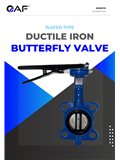
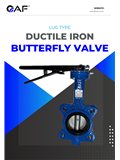
A round disc on a shaft across the bore, turned a quarter turn by a lever. Closed, the disc rim presses into the EPDM liner that lines the bore, and the liner is what seals. Open, the disc turns parallel with the flow but stays in it — so there is always a little restriction.
Four. A wafer or lug body, each in cast iron or ductile iron. The internals are identical across all four: one eight-item parts list. Only the body differs, and the way it bolts into the line.
If the valve sits mid-run and both sides will always be bolted up, wafer is lighter and cheaper. If it may have to sit at the end of a line, or one side needs removing while the other is live, you need lug — its tapped holes hold each flange independently.
The seat is EPDM and the shaft O-ring is NBR, and their compatibility is close to opposite. Cold water, warm water and air suit both — that is this valve’s duty. Mineral oil does not: EPDM swells in it, and the seat is the pressure boundary. The full table is on this page.
Because that is the rubber’s limit, not the iron’s. Cast iron and a CF8 disc would take far more; the EPDM seat and NBR O-ring would not. At the top end the NBR O-ring gives up first.
Because the catalogue prints two. The features box says 150 PSI on all four; the Main Technical Parameter table gives a nominal 1.6 MPa on three of them and 1.0 MPa on the ductile iron wafer. We print both as they stand and advise designing to the lower figure unless we confirm with the factory.
Coarsely. The lever has a notched locking plate, but most of the flow change happens in the last 30 degrees of the stroke, so the response is not linear. For real regulation use a globe valve.
Yes. The top flange is published — 4-7 on ø50 up to 3″, 4-9 on ø70 from 4″ — with a diagonal square head on the stem, and it is the same on all four variants. Above 4″ a gearbox is the right answer anyway, since torque rises sharply at the end of the stroke.
Take that from the flange standard. ASME B16.5 Class 150 uses 4 bolts up to 3″ and 8 from NPS 4 upward. The ANSI column in some of the catalogue tables prints 4 at every size; we reproduce it as published and flag it. The D1 column is a body diameter to check for clearance, not a bolt circle.
We hold them in the Singapore and Malaysia warehouses, out within 24 hours of a PO. Quotes within 2 working hours. Send the size, the body style and the fluid — the seat governs.
Related: semua valve tekanan rendah · gate valves · ball valves · globe valves · Y-strainers · our videos on YouTube.
Baca halaman ini dalam Bahasa Indonesia
