A tee with a screen in the leg. It shuts nothing off — it keeps weld spatter, scale, rust and thread cuttings out of the pumps, control valves, flow meters and regulators behind it. Five variants: ANSI 150 and JIS 10K flanged in cast steel or SS316, and one BSPP/NPT threaded SS316 that reaches 800 PSI.
DN8 to DN100 across the range — the threaded one starts at 1/4″, the flanged ones at 1″.
The highest here, and it is the threaded variant that carries it. The flanged ones are 150# or 10K.
On the SS316 variants. The cast steel ones stop at 150 °C — both on the same PTFE gasket.
Nothing opens, closes or throttles. The screen is the only wear part, and we stock replacements.
Send the size, the end connection and the mesh you need — quotes within 2 working hours.
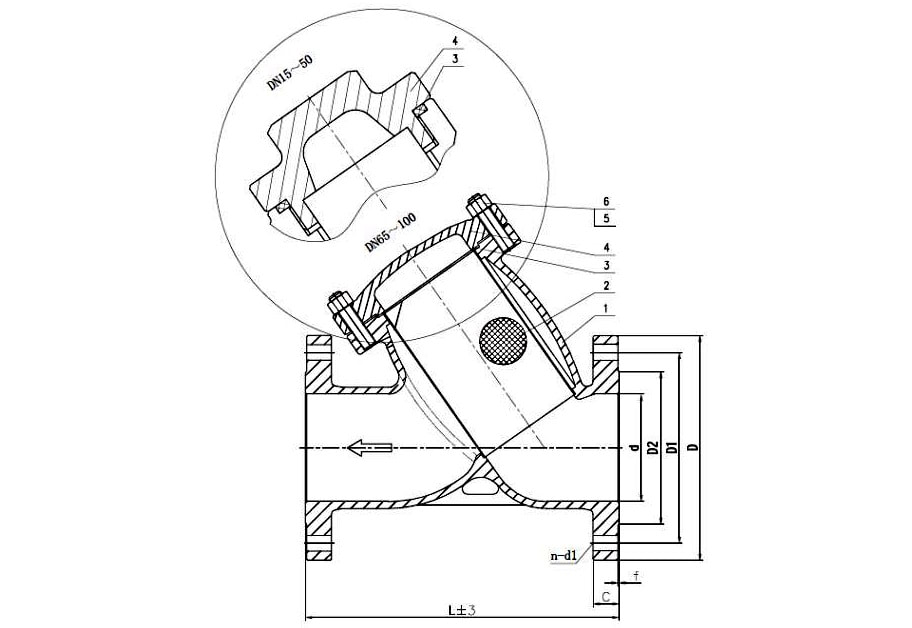
Each has its own page with the full parts list, the dimension table and the sectional drawing.
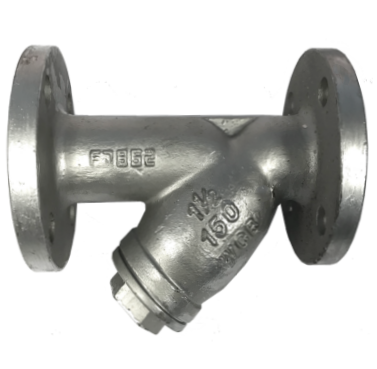
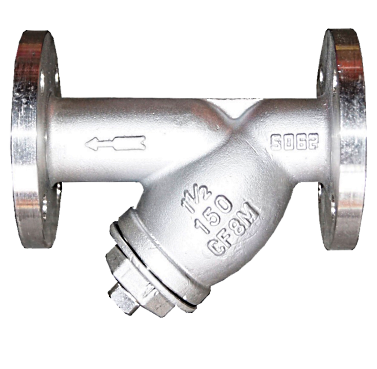
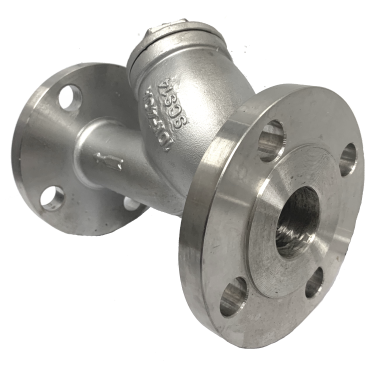
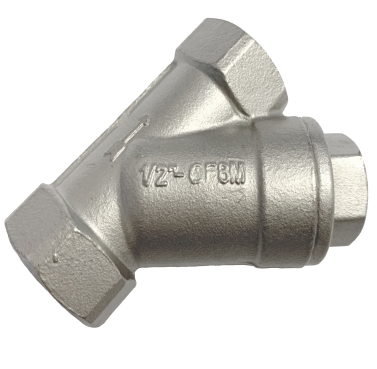
It is not a valve. It shuts nothing off — it catches things.
A Y-strainer is a tee with a screen in the leg. Flow enters, passes through a perforated or woven mesh element angled down into the branch, and leaves clean. Anything larger than the mesh opening stays behind in the leg. Because the leg points downward in service, gravity keeps the debris where the screen already put it, and a cap at the bottom lets you flush or lift it out.
What it catches is rarely the fluid’s fault. It is construction debris — weld spatter, pipe scale, rust, thread cuttings, jointing compound, the odd offcut. A new system sheds all of it in the first weeks of running, and it all arrives at whatever is narrowest downstream: a globe valve seat, control valve trim, a flow meter, a pump impeller, a regulator. Every one of those costs far more than the strainer and takes far longer to replace.
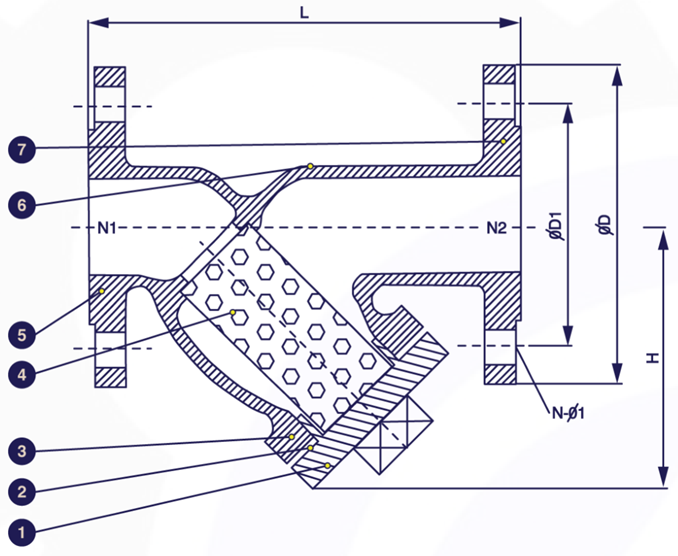
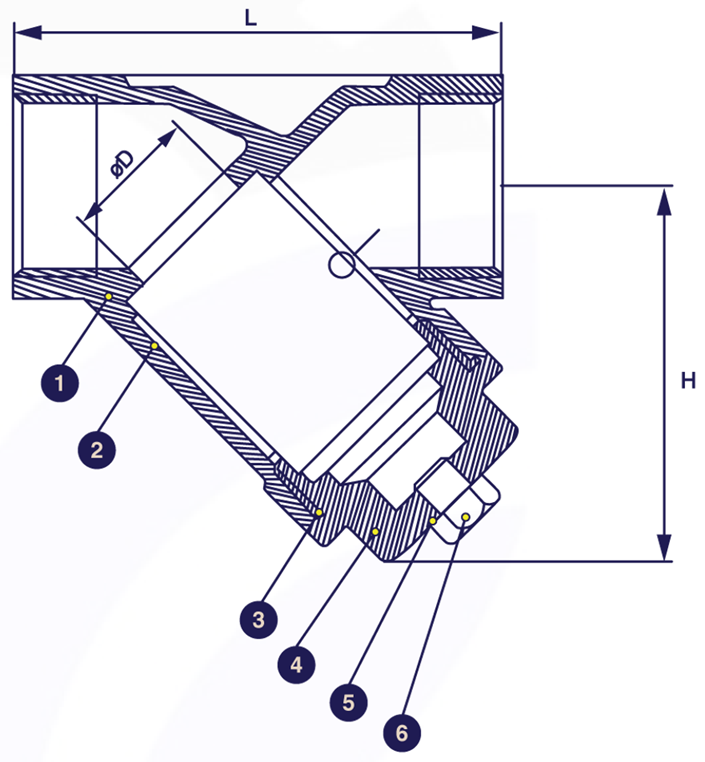
A Y-strainer has no closure member and no handle. Put a gate valve or a ball valve either side so you can take it out of service to clean the screen without draining the line.
A finer screen catches more and blocks sooner, and pressure drop rises as it fills. Choosing mesh is choosing how often someone goes and cleans it.
Everything else is a casting. Screens are SS316 on the stainless variants and SS304 on the cast steel ones — a difference that matters if your fluid carries chlorides.
A clean strainer costs you very little. A blocked one costs you a great deal, and the only way to know which you have is to watch the differential.
Gravity holds the debris in the leg. On a vertical run, flow must be downward. Upside down, a strainer returns everything it has caught to the flow every time the system stops.
The manufacturer catalogue is the reference for every figure below. Anything it does not print — a dimension, a mesh size, a temperature — we obtain from the factory or measure on a stocked unit.
End connection first, then material. The variant column stays put while the table scrolls.
| Variant | Ends | Size | Pressure | Temperature | Body | Screen | Dimension rows |
|---|---|---|---|---|---|---|---|
| ANSI 150 Cast Steel | ANSI 150# flange | 1″–4″ | 150# | −29 °C to 150 °C | A216 WCB cast carbon steel | SS304, 1.0 mm (mesh 40) | 7 |
| ANSI 150 SS316 | ANSI 150# flange | 1½″–4″ | 150# | −20 °C to 230 °C | SS316 / A351 CF8M | SS316, 1.0 mm (mesh 40) | 5 |
| JIS 10K Cast Steel | JIS 10K flange | 1″–4″ | 10K | −29 °C to 150 °C | A216 WCB cast carbon steel | SS304, 1.0 mm (mesh 40) | 7 |
| JIS 10K SS316 | JIS 10K flange | 1½″–4″ | 10K | −20 °C to 230 °C | SS316 / A351 CF8M | SS316, 1.0 mm (mesh 40) | 5 |
| Threaded SS316 | BSPP or NPT threaded | 1/4″–4″ | 800 PSI | −20 °C to 230 °C | SS316 / A351 CF8M | SS316, 0.2 mm or 1.0 mm | 22 |
ANSI 150 and JIS 10K will not bolt to one another despite the similar rating — the bolt circles differ. At 2″ the JIS flange is 155 mm and the ANSI one 152 mm: close enough to look interchangeable, and it is not.
800 PSI on a small SS316 body, more than five times the flanged rating — and the only one that goes down to 1/4″.
Both on the same PTFE gasket, so the 80-degree gap is not explained by the gasket. We print it as published; ask us to confirm if your duty falls between them.
1″ to 4″, where the flanged stainless variants start at 1½″. So 1″ and 1¼″ flanged are cast steel only — below that, use the threaded one.
Everything in the first column is something we stock, so these are not hypothetical pairings.
| What is downstream | What debris does to it | What it costs you |
|---|---|---|
| Globe valve | A globe valve throttles by squeezing flow through a narrow gap, so anything solid arrives at high velocity and cuts the seat and disc face. | The valve. A cut seat that is integral to the body cannot be replaced. |
| Gate valve | Grit settles in the seat pocket at the bottom of the bore, which is exactly where the gate has to land. The valve then will not shut fully. | Isolation. A gate valve that will not seal is no longer a safety device. |
| Ball valve | Particles are dragged across the PTFE seats every time the ball turns, scoring a leak path in a soft material. | The seats, and on a one-piece body the whole valve. |
| Check valve | Debris holds the disc fractionally off its seat, so it passes reverse flow while looking perfectly normal from outside. | Backflow protection, silently — the worst failure mode on this list. |
| Pump | Hard particles pass through the impeller and wear rings at full tip speed. | Efficiency first, then the impeller. The bill arrives months later as energy cost. |
| Flow meter | Fouls a turbine rotor or coats an orifice, and the reading drifts without any alarm. | Trust in your instruments, which is expensive to rebuild. |
| Control valve or regulator | Jams a small trim clearance, so the loop hunts or sticks. | Process stability, and a fault that is hard to diagnose. |
Seventeen sizes, from 10 mesh to 120. All arithmetic checked.
| Mesh | Opening (µm) | Opening (mm) | Opening (in) | Typically catches |
|---|---|---|---|---|
| 10 | 2000 | 2.000 | 0.0787 | Weld spatter, scale, offcuts ← coarsest |
| 12 | 1680 | 1.680 | 0.0661 | Weld spatter, scale, offcuts |
| 14 | 1410 | 1.410 | 0.0555 | Weld spatter, scale, offcuts |
| 16 | 1190 | 1.190 | 0.0469 | Weld spatter, scale, offcuts |
| 18 | 1000 | 1.000 | 0.0394 | Rust flake, jointing compound ← the 1 mm opening |
| 20 | 841 | 0.841 | 0.0331 | Rust flake, jointing compound |
| 25 | 707 | 0.707 | 0.0280 | Rust flake, jointing compound |
| 30 | 595 | 0.595 | 0.0232 | Rust flake, jointing compound |
| 35 | 500 | 0.500 | 0.0197 | Coarse sand, fine scale |
| 40 | 420 | 0.420 | 0.0165 | Coarse sand, fine scale ← the catalogue mesh 40 |
| 45 | 354 | 0.354 | 0.0138 | Coarse sand, fine scale |
| 50 | 297 | 0.297 | 0.0117 | Coarse sand, fine scale |
| 60 | 250 | 0.250 | 0.0098 | Coarse sand, fine scale |
| 70 | 210 | 0.210 | 0.0083 | Fine sediment |
| 80 | 177 | 0.177 | 0.0070 | Fine sediment |
| 100 | 149 | 0.149 | 0.0059 | Fine sediment |
| 120 | 125 | 0.125 | 0.0049 | Fine sediment ← finest |
Mesh number rises, opening falls, filtration improves and pressure drop rises. There is no free end of this table.
On the standard sieve scale, 1.0 mm is 18 mesh and 40 mesh is 0.42 mm — both cannot be right at once. We print it as published and do not pick one for you. If the opening size governs, specify the opening in millimetres on the order and we will confirm the element with the factory.
The manufacturer publishes microns and inches; we have added millimetres because that is what elements get ordered in.
What a screen actually stops depends on particle shape as much as size — a long thin sliver can pass a hole it is much larger than. Size the screen from the smallest clearance you are protecting.
Body, screen and fasteners are not always the same material.
| Variant | Body and cover | Screen | Gasket | Bolt | Nut | BOM items |
|---|---|---|---|---|---|---|
| ANSI 150 Cast Steel | A216 WCB cast carbon steel | SS304, 1.0 mm (mesh 40) | PTFE | ASTM A193 B7 | ASTM A194 2H | 6 |
| ANSI 150 SS316 | SS316 / A351 CF8M | SS316, 1.0 mm (mesh 40) | PTFE | SS304 | SS304 | 7 |
| JIS 10K Cast Steel | A216 WCB cast carbon steel | SS304, 1.0 mm (mesh 40) | PTFE | ASTM A193 B7 | ASTM A194 2H | 6 |
| JIS 10K SS316 | SS316 / A351 CF8M | SS316, 1.0 mm (mesh 40) | PTFE | SS304 | SS304 | 7 |
| Threaded SS316 | SS316 / A351 CF8M | SS316, 0.2 mm or 1.0 mm | PTFE | – | none | 6 |
Body and cover are A216 WCB carbon steel and only the screen is stainless — and it is SS304, not 316. On chloride-bearing service the screen pits before the body does.
The cast steel variants use A193 B7 / A194 2H pressure fasteners, stronger than the SS304 on the stainless ones and less corrosion-resistant. Both as published.
It is the one part that is identical across the range — which is exactly why the 150 °C versus 230 °C gap is hard to explain from the materials.
We stock replacements. Send the size, the variant and the mesh — a torn screen filters nothing and gives no sign that it has stopped.
As printed in the catalogue. Where it is inconsistent we show it rather than tidy it away.
| Variant | Design | End connection | Inspection and test |
|---|---|---|---|
| ANSI 150 Cast Steel | ASME B16.34 | ASME B16.5 | API 598 |
| ANSI 150 SS316 | ANSI B16.34 | ASME B16.5 | API 598 |
| JIS 10K Cast Steel | JIS B2071 | JIS B2220 | JIS B2003 |
| JIS 10K SS316 | ANSI B16.34 | JIS B2220 | API 598 |
| Threaded SS316 | – | – | – |
On a JIS flanged strainer. The JIS cast steel variant prints JIS B2071. The flange connection is JIS B2220 on both, and that is what decides whether it bolts up. We print it as published.
The threaded sheet gives a working rating and a dimension table, but no standards line and no test-pressure table. We do not borrow either from a sibling variant.
One shared test standard is what makes the figures on the variant pages comparable. The JIS cast steel one is tested to JIS B2003 instead.
Factory proof tests. Not a working pressure.
| Variant | Pressure | Working temperature | Shell / strength test | Seal / tightness test | Gasket |
|---|---|---|---|---|---|
| ANSI 150 Cast Steel | 150# | −29 °C to 150 °C | 3.0 MPa | – | PTFE |
| ANSI 150 SS316 | 150# | −20 °C to 230 °C | – (printed “/”) | 3.0 MPa | PTFE |
| JIS 10K Cast Steel | 10K | −29 °C to 150 °C | 3.0 MPa | – | PTFE |
| JIS 10K SS316 | 10K | −20 °C to 230 °C | 3.0 MPa | – | PTFE |
| Threaded SS316 | 800 PSI | −20 °C to 230 °C | not published | not published | PTFE |
Where 3.0 MPa is published it is roughly twice the nominal rating and exists to prove the casting. Do not design to it.
Differential pressure across a blocking screen is what collapses an element, and it happens far below the shell rating. It gives no warning — unless you fit gauges.
ANSI SS316 prints 3.0 MPa against tightness and a slash against shell; JIS SS316 calls it a strength test; both cast steel sheets call it a shell test; the threaded one prints no table at all. We leave the factory labels as they are.
Five steps, and two of them are the ones most often skipped.
The arrow is cast into the casting. Fitted backwards, the screen sits on the wrong side of the flow and the strainer filters nothing.
On a horizontal run the leg hangs below. On a vertical run, flow must be downward. That is the only way gravity works for you rather than against you.
A gate valve or ball valve upstream and downstream. Without them, cleaning the screen means draining the line.
Record the differential with a clean screen, on day one. That figure is the baseline; without it there is no way to know when to clean except waiting for something to go wrong.
The screen comes out downward through the cover. Measure that clearance before you fit it, not after.
A new system sheds its own construction debris. The cleaning interval in the first month has nothing to do with the interval once the system settles.
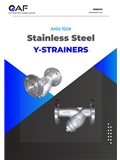
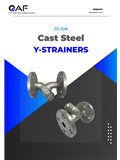
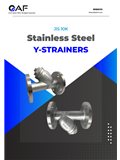
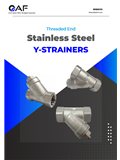
A tee with a screen in the leg. Flow passes through a mesh element angled down into the branch, anything larger than the opening stays behind, and a cap at the bottom lets you flush it out. No moving parts — it does not open, close or throttle, and it does not isolate.
Because what sits behind it costs more. Weld spatter, pipe scale, rust, thread cuttings and jointing compound all travel with the flow and arrive at whatever is narrowest downstream — a globe valve seat, control valve trim, a flow meter, a pump impeller. A new system sheds all of it in the first weeks of running.
Five. Four flanged — ANSI 150 and JIS 10K, each in cast steel or SS316 — and one threaded SS316 in BSPP or NPT. The threaded one reaches 800 PSI and goes down to 1/4″; the flanged ones are 150# or 10K and start at 1″.
No. The pressure ratings are similar, the drilling is not. At 2″ the JIS flange is 155 mm and the ANSI one 152 mm — close enough to look interchangeable. Check the bolt circle, not the pressure.
Work back from the smallest clearance you are protecting and choose a screen finer than that — then no finer than you need, because every step finer raises pressure drop and shortens the interval between cleanings. The full chart, 10 mesh to 120, is on this page.
On the standard sieve scale the two cannot both be right: 1.0 mm is 18 mesh, and 40 mesh is 0.42 mm. We print it as published and do not pick one for you. If the opening size governs, specify the opening in millimetres on the order and we will confirm the element with the factory.
Cap pointing downward, flow following the arrow cast into the body. On a vertical run, flow must be downward. Fit isolation and a pressure gauge either side, and leave clearance below it — the screen comes out downward through the cover.
There is no fixed interval; it depends entirely on how dirty your fluid is. Fit gauges either side and record the drop when the screen is clean; that baseline is what every later reading is judged against. Check often in the first weeks of a new system.
Two levels: the SS316 variants to 230 °C, the cast steel ones to 150 °C — both on the same PTFE gasket, so the gap is not explained by the gasket. We print it as published; ask us to confirm with the factory if your duty falls between them.
We hold them in the Singapore and Malaysia warehouses, out within 24 hours of a PO. Quotes within 2 working hours. We stock replacement screens too — send the size, the variant and the mesh.
Related: semua valve tekanan rendah · gate valves · globe valves · ball valves · check valves · our videos on YouTube.
Baca halaman ini dalam Bahasa Indonesia
