A Y-strainer in 1/4″–4″ (DN8–DN100) with BSPP or NPT threaded ends and a body in SS316 / A351 CF8M. Screen in SS316, 0.2 mm or 1.0 mm, gasket in PTFE. Rated 800 PSI at −20 °C to 230 °C. It is a tee with a screen in the leg — no moving parts, and it does not isolate.
Send the size, the end connection and the mesh you need — quotes within 2 working hours.
| Ends | BSPP or NPT threaded |
|---|---|
| Size | 1/4″–4″ (DN8–DN100) |
| Body and cover | SS316 / A351 CF8M |
| Screen | SS316, 0.2 mm or 1.0 mm |
| Gasket | PTFE |
| Pressure | 800 PSI |
| Temperature | −20 °C to 230 °C |
| Moving parts | None |
| Orientation | Cap pointing downward |
It strains, it does not isolate. BSPP or NPT threaded ends.
It is a tee with a screen in the leg. Flow passes through a mesh element angled down into the branch, anything larger than the opening stays behind, and a cap at the bottom lets you flush it out or lift the screen for cleaning. There are no moving parts and it does not shut anything off.
This variant: 1/4″–4″ (DN8–DN100), BSPP or NPT threaded ends, body and cover in SS316 / A351 CF8M, screen in SS316, 0.2 mm or 1.0 mm, gasket in PTFE. Rated 800 PSI at −20 °C to 230 °C. The parts list runs to 6 items — there is not much to a strainer, which is exactly the point.
Weld spatter, pipe scale, rust, thread cuttings and jointing compound all travel with the flow and all arrive at whatever is narrowest downstream — a globe valve seat, control valve trim, a flow meter, a pump impeller. The strainer is always the cheap part.
It has no moving parts and cannot shut off. To clean the screen without draining the line, fit isolation either side of it.
Gravity holds the debris in the leg instead of letting it fall back into the flow every time the system stops. Flow follows the arrow cast into the body. On a vertical run, flow must be downward.
Everything else is a casting or a fastener. It is the part to keep a spare of, and the part to ask us about first.
The same on all five variants in this range — which is what makes the temperature differences between them hard to explain from the materials alone.
The screen comes out downward through the cover. A strainer you cannot get the screen out of is a strainer nobody cleans, and a screen nobody cleans eventually tears.
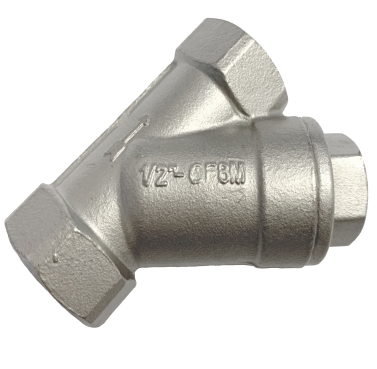
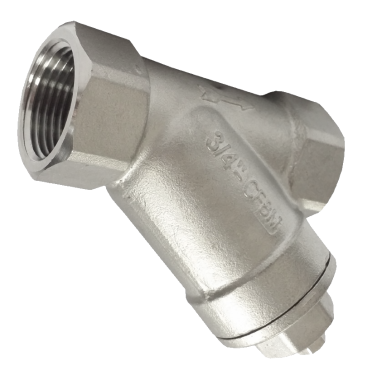
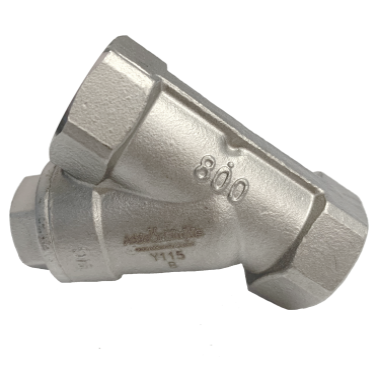
Photographs of the stocked item, not renders.
So the strainer can be identified on the wall with no paperwork. If you need to confirm an installed unit, send us a photograph.
The screen comes out downward through that cover. Look at how much room it needs before you decide where to fit it.
If you need to identify a part before ordering spares, ask — we will number it up on a photograph of a unit in the warehouse.
Everything that goes on a purchase order.
| Item | Value |
|---|---|
| Size range | 1/4″–4″ (DN8–DN100) |
| End connection | BSPP or NPT threaded |
| Working pressure | 800 PSI |
| Working temperature | −20 °C to 230 °C |
| Body and cover | SS316 / A351 CF8M |
| Screen | SS316, 0.2 mm or 1.0 mm |
| Gasket | PTFE |
| Design | – |
| End connection standard | – |
| Inspection and test | – |
| Moving parts | None. A strainer does not open, close or throttle |
| Parts in the list | 6 |
| Orientation | Cap pointing downward, flow following the arrow on the body |
| Cleaning | Flush through the bottom cap, or lift the screen out through the cover |
| Stock | Held in Malaysia or Singapore |
22 rows. Millimetres, weights in kilogrammes.
The dimension that decides whether it fits is the end-to-end length L — the gap it needs in the run. And leave clearance below it: the screen comes out downward through the cover, and on the larger sizes that is not a small allowance.
| Size | Thread | Part no | Screen bore ØD | Face-to-face L | Height H | Weight (kg) |
|---|---|---|---|---|---|---|
| 1/4″ | BSPP | VL-S-YS-G-800-04 | 9 | 65 | 35 | – |
| 3/8″ | BSPP | VL-S-YS-G-800-06 | 9 | 65 | 35 | – |
| 1/2″ | BSPP | VL-S-YS-G-800-08 | 14 | 61 | 43 | 0.19 |
| 3/4″ | BSPP | VL-S-YS-G-800-12 | 18 | 80 | 50 | 0.38 |
| 1″ | BSPP | VL-S-YS-G-800-16 | 22 | 84 | 63 | 0.55 |
| 1¼″ | BSPP | VL-S-YS-G-800-20 | 28 | 99 | 70 | 0.68 |
| 1½″ | BSPP | VL-S-YS-G-800-24 | 38 | 108 | 82 | 0.94 |
| 2″ | BSPP | VL-S-YS-G-800-32 | 48 | 131 | 94 | 1.60 |
| 2½″ | BSPP | VL-S-YS-G-800-40 | 70 | 175 | 115 | 2.70 |
| 3″ | BSPP | VL-S-YS-G-800-48 | 80 | 190 | 135 | 4.10 |
| 4″ | BSPP | VL-S-YS-G-800-64 | 110 | 240 | 152 | 7.20 |
| 1/4″ | NPT | VL-S-YS-N-800-04 | 9 | 65 | 35 | – |
| 3/8″ | NPT | VL-S-YS-N-800-06 | 9 | 65 | 35 | – |
| 1/2″ | NPT | VL-S-YS-N-800-08 | 14 | 61 | 43 | 0.19 |
| 3/4″ | NPT | VL-S-YS-N-800-12 | 18 | 80 | 50 | 0.38 |
| 1″ | NPT | VL-S-YS-N-800-16 | 22 | 84 | 63 | 0.55 |
| 1¼″ | NPT | VL-S-YS-N-800-20 | 28 | 99 | 70 | 0.68 |
| 1½″ | NPT | VL-S-YS-N-800-24 | 38 | 108 | 82 | 0.94 |
| 2″ | NPT | VL-S-YS-N-800-32 | 48 | 131 | 94 | 1.60 |
| 2½″ | NPT | VL-S-YS-N-800-40 | 70 | 175 | 115 | 2.70 |
| 3″ | NPT | VL-S-YS-N-800-48 | 80 | 190 | 135 | 4.10 |
| 4″ | NPT | VL-S-YS-N-800-64 | 110 | 240 | 152 | 7.20 |
A strainer you cannot get the screen out of is a strainer nobody cleans, and a screen nobody cleans eventually tears.
On a replacement, measure the unit coming out rather than trusting a drawing.
A strainer must not hang on the pipework, and it must never be used to pull a misaligned flange together.
The column headings here are the letters on the sectional drawing below. Where a letter is ambiguous we have left it as published rather than guess at it.
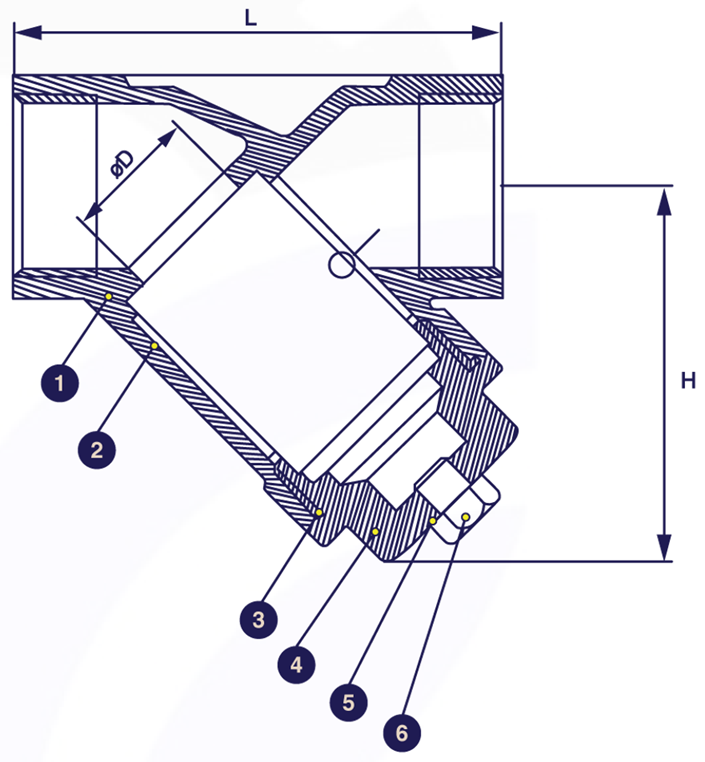
6 callouts, and 6 items in the parts list below — the two match one for one. The dimension letters are the column headings in the size table above: L face-to-face, ØD the screen bore and H from the centreline down to the plug.
Callout numbers are the item numbers in the parts list below, and the dimension letters are the column headings in the size table above. Nothing on the drawing is named only there.
It sits angled down into the leg, so debris falls away from the flow rather than back into it. That is why the fitted orientation matters.
This is a catalogue section, not a manufacturing drawing: no tolerances and no material callouts. Order spares by the item numbers in the parts list.
All 6 parts. There is not much to a strainer, which is the point.
| No. | Part name | Material |
|---|---|---|
| 1 | Body | SS316, CF8M |
| 2 | Filter | SS316 |
| 3 | Gasket | PTFE |
| 4 | Cap | SS316, CF8M |
| 5 | Gasket | PTFE |
| 6 | Plug | SS316 |
They match the callouts on the sectional drawing above, so a spares order matches the section rather than a description.
Everything else is a casting or a fastener. We stock replacement screens — send the size, the variant and the mesh.
Not the body. It is also the part that sets: a little re-torquing of the cover bolts after the first heat cycle is normal.
If you need to know what touches your fluid, the whole list is above — we have not summarised it.
Where 3.0 MPa is published it is roughly twice the nominal rating and exists to prove the casting. Do not design to it.
Differential pressure across a blocking screen is what collapses an element, and that happens far below the shell rating. It is the real failure mode, and it gives no warning.
Record the drop when the screen is clean. That baseline is what every later reading is judged against — without it there is no way to know when to clean.
End connection first, then material, then mesh.
All five side by side: the comparison table.
A Y-strainer in 1/4″–4″ (DN8–DN100) with BSPP or NPT threaded ends, body and cover in SS316 / A351 CF8M and a screen in SS316, 0.2 mm or 1.0 mm. Rated 800 PSI at −20 °C to 230 °C. It is a tee with a screen in the leg — no moving parts, and it does not isolate.
Keeping pipeline debris out of the equipment behind it. Weld spatter, scale, rust, thread cuttings and jointing compound all travel with the flow and all arrive at whatever is narrowest downstream — a globe valve seat, control valve trim, a flow meter, a pump impeller. Every one of those costs more than the strainer and takes longer to replace.
Work back from the smallest clearance you are protecting and choose a screen finer than that — then do not go finer than you need, because every step finer raises pressure drop and shortens the interval between cleanings. This variant is published with a SS316, 0.2 mm or 1.0 mm screen; tell us if you need another.
Finer. Mesh number counts openings across one linear inch, so more openings in the same inch means smaller openings: 10 mesh passes 2000 microns, 120 mesh passes 125.
Cap pointing downward, so gravity holds the debris in the leg instead of letting it fall back into the flow every time the system stops. Flow follows the arrow cast into the body. On a vertical run, flow must be downward. And leave clearance below it, because the screen comes out downward through the cover.
There is no fixed interval and anyone who gives you one is guessing — it depends entirely on how dirty your fluid is. Fit a pressure gauge either side and record the drop when the screen is clean; that baseline is what every later reading is judged against. Expect to check often in the first weeks of a new system, when the pipework is shedding its own construction debris.
Body and cover in SS316 / A351 CF8M, screen in SS316, 0.2 mm or 1.0 mm, gasket in PTFE. The parts list runs to 6 items and all of it is published on this page.
It has BSPP or NPT ends — and the two do not interchange. BSPP is parallel and seals on a bonded seal or a face; NPT is tapered and seals on the thread. Tell us which your pipework uses; the part numbers differ (-G- for BSPP, -N- for NPT) even though the dimensions are identical.
The sheet for this variant prints no test-pressure table — the four flanged variants have one, the threaded sheet does not. We do not borrow figures from a sibling variant; if you need one for a document, we will ask the factory.
Yes — the screen is the only wear part on the whole assembly and we stock them. Send the size, the variant and the mesh you want. Keeping one on the shelf is the difference between a clean and a shutdown, because a torn screen filters nothing and gives no sign that it has stopped.
Related: all Y-strainers · gate valves · ball valves · check valves · our videos on YouTube.