An all-stainless ANSI 150# flange end swing check valve — body, disc, arm and hinge pin in SS316 with A351 CF8M, PTFE gasket. 1/2″ to 4″ (DN15–DN100), the widest flanged range at the small end. Shell tested 3.0 MPa, seal 2.2 MPa.
State the size, the fluid and the flow direction — quotes within 2 working hours.
| Ends | ANSI 150# flange — must match your pipework |
|---|---|
| Range | 1/2″ to 4″ (DN15–DN100), eight sizes |
| Pressure | Class 150 |
| Temperature | not published — we obtain it from the factory |
| Body and disc | SS316 with A351 CF8M |
| Gasket | PTFE |
| Shell / seal test | 3.0 MPa / 2.2 MPa |
| Moving parts | One — the disc, on its hinge pin |
The eight-size dimension table with part numbers, the 9-item bill of materials and the test-pressure table are all on this page, as printed in the catalogue.
The same valve as the cast steel version, in an entirely different material.
A disc on a hinge inside an SS316 body, with ANSI 150# flanges at both ends, in 1/2″ to 4″ (DN15 to DN100). The cast parts use A351 CF8M — the cast form of 316, not a lesser grade. The gasket is PTFE.
The flange is the same as the cast steel variant, the test pressures are the same, and it works the same way. Two things differ: the material — no carbon steel anywhere — and the size range, which starts at 1/2″ where cast steel only starts at 1½″. The cast steel answers back with 425 °C and sizes to 6″.
Body, disc, arm and bonnet in SS316 with CF8M where cast; hinge pin, bolt and nut in SS316. Everything wetted is SS316 or PTFE.
It starts at 1/2″, three sizes below where the cast steel begins. If the line is small and flanged, this is the only ANSI 150 option available.
The catalogue prints none. Three of the five swing check variants are the same — only the cast steel and the threaded SS316 state a temperature. We do not copy a figure across; we obtain it from the factory when it is needed.
That is the trade against the cast steel version: PTFE is more inert and cleaner, graphite takes more heat. For corrosive duty you want this one; for hot duty you want that one.
The disc, on an SS316 hinge pin. No handle, stem or actuator — so there is no packing and no gland to leak externally.
The range steps from 1″ to 1½″. Eight sizes in total, not nine.
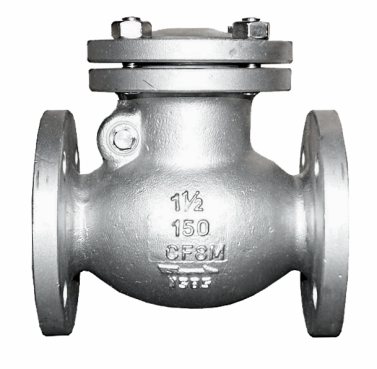
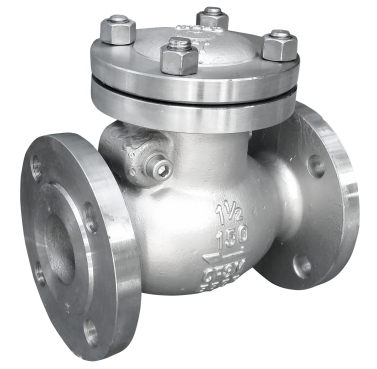
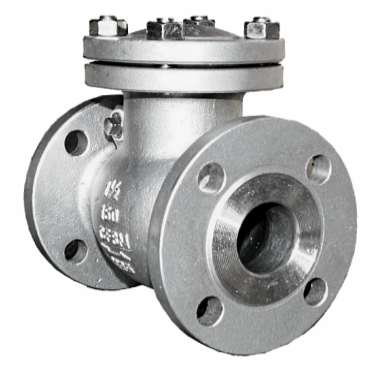
All photographs of the stocked item, not renders.
A bright stainless body with the bolted bonnet above it. The same arrangement as the cast steel version — what differs is the material.
“1½ · 150 · CF8M” cast into the body. Size, class and material grade are in the casting, so the valve can be identified without paperwork.
Bolted bonnet above, raised face and bolt holes at the ends. The disc comes out through the top — leave headroom.
Everything that goes on a purchase order.
| Item | Detail |
|---|---|
| Size range | 1/2″ to 4″ (DN15 to DN100) |
| End connection | ANSI 150# flange |
| Working pressure | Class 150 |
| Working temperature | not published |
| Body and disc | SS316 with A351 CF8M cast stainless |
| Gasket | PTFE |
| Shell test | 3.0 MPa |
| Seal test | 2.2 MPa |
| Moving parts | One — the disc, on its hinge pin |
| Parts in the list | 9 |
| Operation | Automatic. No handle, stem or actuator |
| Orientation | Flow follows the cast arrow · bonnet up on a horizontal run · flow upward on a vertical run |
| Not an isolating valve | Fit a gate valve or ball valve as well if you need to shut the line |
| Stock | Singapore and Malaysia warehouses — out within 24 hours |
Eight sizes, dimensions in millimetres. L face-to-face is the gap it needs in the run; D1 the bolt circle and z-d the hole pattern have to match the mating flange.
| Size | Part no | DN | Lubang | Flange OD D | Bolt circle D1 | Raised face D2 | Face-to-face L | Bolts z-d | Flange thk b |
|---|---|---|---|---|---|---|---|---|---|
| 1/2″ | VL-S-SC-F-150-08 | 15 | 15 | 89 | 60.5 | 35 | 152 | 4-19 | 11.1 |
| 3/4″ | VL-S-SC-F-150-12 | 20 | 20 | 98.5 | 70 | 43 | 178 | 4-19 | 11.1 |
| 1″ | VL-S-SC-F-150-16 | 25 | 25 | 108 | 79.2 | 51 | 127 | 4-19 | 11.1 |
| 1½″ | VL-S-SC-F-150-24 | 40 | 38 | 127 | 98.6 | 73 | 165 | 4-19 | 14.3 |
| 2″ | VL-S-SC-F-150-32 | 50 | 50 | 152 | 120.7 | 92 | 203 | 4-19 | 15.9 |
| 2½″ | VL-S-SC-F-150-40 | 65 | 65 | 178 | 139.7 | 105 | 216 | 4-19 | 17.5 |
| 3″ | VL-S-SC-F-150-48 | 80 | 80 | 190 | 152.4 | 127 | 241 | 4-19 | 19.5 |
| 4″ | VL-S-SC-F-150-64 | 100 | 100 | 230 | 190.5 | 157.2 | 292 | 8-19 | 24.3 |
Raised face height f is 2 mm at every size, as printed.
152 mm at 1/2″, 178 mm at 3/4″, then down to 127 mm at 1″ — after which it rises regularly to 292 mm at 4″. The first two sizes do not follow the ASME B16.10 pattern the rest do. We print it as published; on a tight replacement, measure the gap in your run and we confirm against a stocked unit.
There the DN is 40 but the bore is 38 mm. At every other size the two match.
ANSI 150# will not bolt to a JIS 10K flange, whatever the pressure rating says.
Four 19 mm holes from 1/2″ to 3″, then eight at 4″. Flange thickness b rises regularly from 11.1 mm to 24.3 mm.
This table carries neither. For support or overhead clearance calculations, ask us and we will measure a stocked unit.
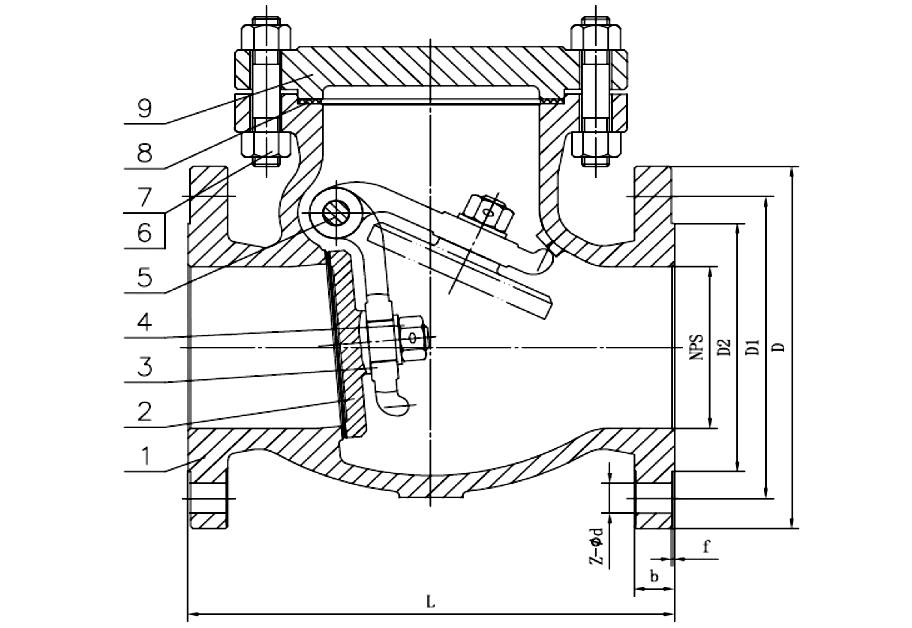
Numbered to match the parts list below. The section shows the disc on its arm and hinge pin, the seat it lands on, and the bolted bonnet that has to come off to get it out.
| No | Part name | Material |
|---|---|---|
| 1 | Body | SS316 dan CF8M |
| 2 | Disc | SS316 dan CF8M |
| 3 | Arm | SS316 dan CF8M |
| 4 | Nut | SS316 |
| 5 | Hinge Pin | SS316 |
| 6 | Bolt | SS316 |
| 7 | Nut | S316 (as printed) |
| 8 | Gasket | PTFE |
| 9 | Bonnet | SS316 dan CF8M |
Nine items, all SS316, CF8M or PTFE. Compare that with the cast steel variant, whose body is A216 WCB and whose bolting is alloy steel.
Not a lesser grade — it is the correct specification for a cast part, and chemically equivalent to wrought 316.
Not SS316. We publish the list as printed rather than silently correcting it — it is almost certainly SS316 like the other nut in the same list, but we do not guess. Ask us if it matters for a spares order.
And it is the only thing separating this list from the JIS 10K list, which is identical except that its cast grade is SCS14A.
The disc, on its arm and hinge pin. No stem, no packing, no gland — so there is no external leak path other than the bonnet gasket.
Factory proof tests. Not working pressures.
| Item | Value |
|---|---|
| Nominal pressure | 150# |
| Shell test | 3.0 MPa |
| Seal test | 2.2 MPa |
| Air seal test | 0.4 – 0.7 MPa |
| Max working temperature | not published |
They are manufacturing proof tests well above the working rating. The valve is not intended to operate there.
0.4 to 0.7 MPa, not a single figure — unlike the cast steel variant, which prints 0.6 MPa exactly. As printed.
The catalogue prints none. If your duty has a temperature limit, say so and we will get the figure from the factory — we will not borrow the 425 °C from the cast steel variant or the 180 °C from the threaded one.
All five, side by side: the comparison table.
Dimensions and part numbers are in the catalogue, as printed; stock, price and working temperature are not — send the list and we confirm all three.
Material and temperature, not the flange. Both are ANSI 150# and both are shell tested at 3.0 MPa and seal tested at 2.2 MPa. This one is stainless throughout — body, disc, arm, hinge pin and bonnet in SS316 with CF8M — with a PTFE gasket. The cast steel is carbon steel A216 WCB with a graphite gasket, and it is rated to 425 °C where this variant states no temperature at all.
Because the catalogue does not print one. Three of the five swing check variants state no temperature; only the cast steel and the threaded SS316 do. We do not copy a figure across from another variant — if temperature matters for your duty, say so and we will get it from the factory.
1/2″ to 4″ (DN15 to DN100), eight sizes. This is the widest flanged range at the small end — the cast steel variant only starts at 1½″. Note there is no 1¼″ in the list.
As printed: 152 mm at 1/2″, 178 mm at 3/4″, then 127 mm at 1″, after which it rises regularly to 292 mm at 4″. The first two sizes do not follow the ASME B16.10 pattern the rest do. On a tight replacement, measure the gap in your run before ordering and we confirm against a stocked unit.
Body, disc, arm and bonnet in SS316 with A351 CF8M where cast; hinge pin, bolt and nut in SS316; PTFE gasket. Everything wetted is SS316 or PTFE — there is no carbon steel anywhere.
That is how the catalogue prints it. We publish the list as printed rather than silently correcting it — it is almost certainly SS316 like the other nut in the same list, but we do not guess. Ask us if it matters for a spares order.
Flow follows the arrow cast into the body; on a horizontal run the bonnet points up; on a vertical run flow must be upward. It must never be used on downward flow — for that use a spring check.
No. An ANSI 150# flange does not mate with JIS 10K. For JIS pipework use the JIS 10K SS316 variant — the same stainless valve on Japanese flanges.
Held in our Singapore and Malaysia warehouses, out within 24 hours of your PO; quotes within 2 working hours.
Related: all swing check valves · ANSI 150 cast steel for hot duty or above 4″ · Y-strainers to fit upstream · all low pressure valves.