
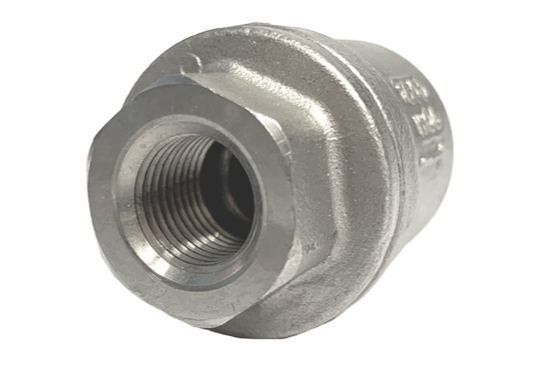
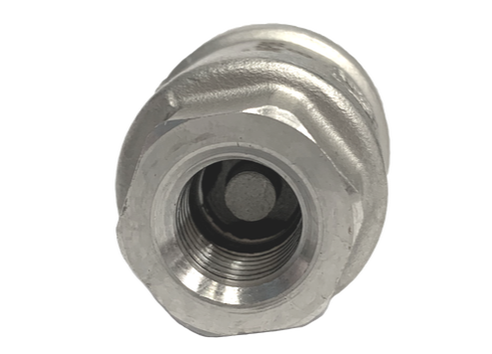
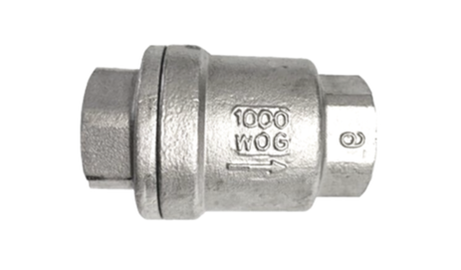
A check valve using a spring-loaded inline poppet in 1/4″–2″ (DN8–DN50) with BSPP or NPT, female both ends ends, a SS316 / CF8M body and Metal or Viton seat. It works in any orientation — a spring closes it, not gravity. Temperature −29 °C to 150 °C.
Send the size, the thread and the seat type — quotes within 2 working hours.
| Type | Inline poppet · BSPP or NPT · 1000 PSI |
|---|---|
| Size | 1/4″–2″ (DN8–DN50) |
| Ends | BSPP or NPT, female both ends |
| Body | SS316 / CF8M |
| Seat | Metal or Viton seat |
| Pressure | 1000 PSI |
| Temperature | −29 °C to 150 °C |
| Closes on | A spring — any orientation |
| Cracking pressure | 1 Bar |
A spring closes it, not gravity — so orientation is free.
An inline poppet. Forward flow pushes a disc back along the axis of the valve against a spring; when flow falls away, the spring pushes the disc back onto its seat before reverse flow has properly started. Everything happens inside a smooth barrel with a screwed-in cap — no bonnet, no hinge and nothing on the outside that moves.
Two things follow from that, and they are the whole reason to choose this valve over a swing check. First, gravity is not part of the mechanism, so the valve works in any orientation — including a vertical run with flow downward, where a swing check simply will not close. Second, because the spring starts closing it as flow decays rather than waiting for reversal, it closes earlier and more gently.
A spring closes it, not gravity — so unlike a swing check valve there are no rules about which way up it goes. Flow must still follow the arrow.
Debris on the seat holds the disc fractionally open and it passes reverse flow while looking normal. Fit a Y-strainer upstream, and inspect it when you get the chance.
No bonnet to weep, no hinge pin to wear, no cap to work loose. It is the most compact and the most sealed of the check valves we stock.
Against 200 PSI for the threaded SS316 swing check and 300 PSI for the brass one. If your small-bore line is anywhere near those figures, this is the valve.
Orientation stops mattering; direction never does. Fitted backwards, any check valve blocks the line.
Not the body. The body is SS316; what limits it is the elastomer or the metal at the seat, and that is the thing to specify.
Photographs of the stocked item, not renders.
So the valve can be identified with no paperwork. If you need to confirm an installed unit, send us a photograph and we will read it.
If you need to identify a part before ordering spares, ask — we will number it up on a photograph of a unit in the warehouse.
Everything that goes on a purchase order.
| Item | Value |
|---|---|
| Size range | The features box says 1/4″–2″ (DN8–DN50); the dimension list runs 1/2″–3″ — both as printed |
| End type | BSPP or NPT, female both ends |
| Thread | BSPP or NPT |
| Body | SS316 / CF8M |
| Seat | Metal or Viton seat |
| Working temperature | −29 °C to 150 °C |
| Working pressure | 1000 PSI |
| Cracking pressure | 1 Bar |
| Design | – |
| Face-to-face | – |
| Inspection and test | – |
| Closes on | A spring — works in any orientation |
| Parts in the list | Metal seat 4; Viton seat 6 |
| Stock | Held in Malaysia or Singapore |
The features box says 1/4″–2″; the dimension list runs 1/2″ to 3″. We print both and do not pick one. Tell us the size you need and we will confirm availability with the factory.
A metal seat (4 parts) or a Viton seat (6 parts, with a Viton O-ring and a PTFE seal gasket). The part numbers differ — the -VI- insert marks the Viton version.
There is no design, face-to-face or inspection line in this variant catalogue. We do not borrow them from a sibling; if you need them for a document, we will ask the factory.
14 rows. Millimetres.
Part numbers are given in pairs: the first is the metal seat, the second — with the -VI- insert — the Viton seat. The dimensions are identical on both.
| Size | Thread | Part no — metal / Viton | ØD | H | ØE | T | Weight (kg) |
|---|---|---|---|---|---|---|---|
| 1/2″ | BSPP | VL-S-VC-G-1000-08 / -VI-08 | 14 | 62 | 39 | 27 | 0.25 |
| 3/4″ | BSPP | VL-S-VC-G-1000-12 / -VI-12 | 19 | 69 | 43 | 32 | 0.36 |
| 1″ | BSPP | VL-S-VC-G-1000-16 / -VI-16 | 24 | 82 | 48 | 38 | 0.48 |
| 1¼″ | BSPP | VL-S-VC-G-1000-20 / -VI-20 | 30 | 93 | 58 | 47 | 0.85 |
| 1½″ | BSPP | VL-S-VC-G-1000-24 / -VI-24 | 38 | 102 | 71 | 55 | 1.32 |
| 2″ | BSPP | VL-S-VC-G-1000-32 / -VI-32 | 48 | 116 | 81 | 68 | 1.88 |
| 3″ | BSPP | VL-S-VC-G-1000-48 / -VI-48 | 78 | 170 | 140 | 98 | – |
| 1/2″ | NPT | VL-S-VC-N-1000-08 / -VI-08 | 14 | 62 | 39 | 27 | 0.25 |
| 3/4″ | NPT | VL-S-VC-N-1000-12 / -VI-12 | 19 | 69 | 43 | 32 | 0.36 |
| 1″ | NPT | VL-S-VC-N-1000-16 / -VI-16 | 24 | 82 | 48 | 38 | 0.48 |
| 1¼″ | NPT | VL-S-VC-N-1000-20 / -VI-20 | 30 | 93 | 58 | 47 | 0.85 |
| 1½″ | NPT | VL-S-VC-N-1000-24 / -VI-24 | 38 | 102 | 71 | 55 | 1.32 |
| 2″ | NPT | VL-S-VC-N-1000-32 / -VI-32 | 48 | 116 | 81 | 68 | 1.88 |
| 3″ | NPT | VL-S-VC-N-1000-48 / -VI-48 | 78 | 170 | 140 | 98 | – |
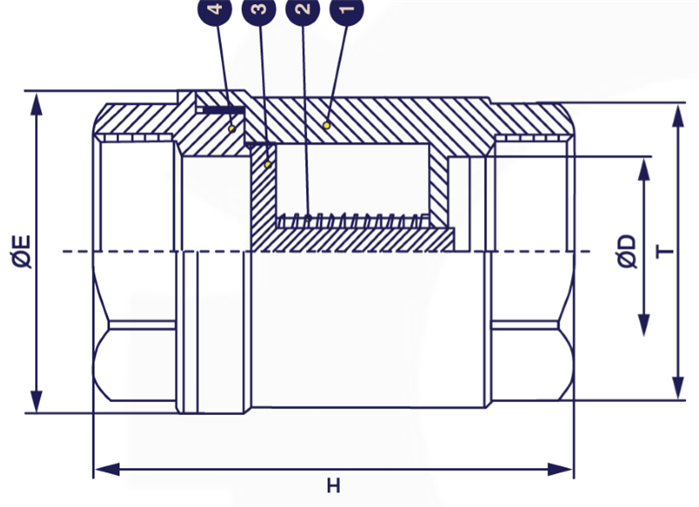
The column headings here are the letters on the sectional drawing below. Where a letter is ambiguous we have left it as published rather than guess at it.
H is the end-to-end length. On a replacement, measure the unit coming out.
The 3″ row is blank in the weight column, as printed. If you need the figure, we will weigh a stocked unit.
Anything missing from this table we measure off a stocked valve, same day. Just say which dimension.
Metal seat — 4 callouts, 4 parts.
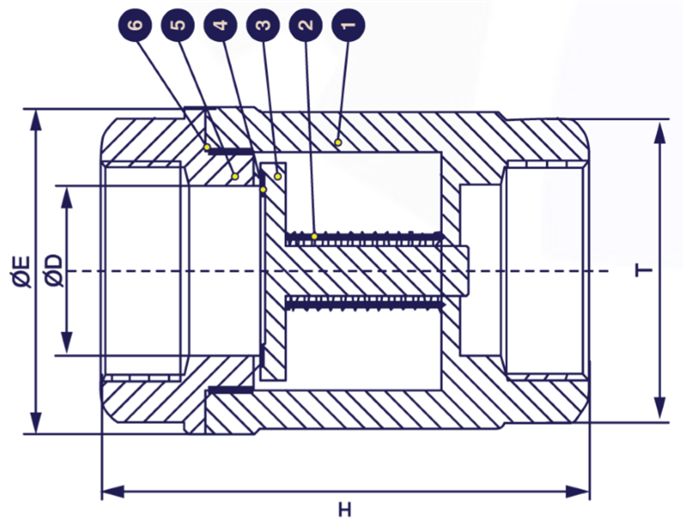
Viton seat — 6 callouts, 6 parts: a Viton O-ring and a PTFE seal gasket on top.
Callout numbers correspond to the item numbers in the parts lists below — one list per seat type. The dimension letters are the column headings in the size table above: H end-to-end length, ØD the bore, ØE the body OD and T across the hex flats.
Callout numbers are the item numbers in the parts list below, and the dimension letters are the column headings in the size table above.
Everything else is a casting, the spring or a fastener. Those two surfaces take the duty every time the valve closes.
This is a catalogue section, not a manufacturing drawing: no tolerances and no material callouts. Order spares by the item numbers in the parts list.
Two lists — one per seat type.
Metal seat
| No. | Part name | Material |
|---|---|---|
| 1 | Body | SS316, CF8M |
| 2 | Spring | SS316 |
| 3 | Disc | SS316, CF8M |
| 4 | Cap | SS316, CF8M |
Viton seat
| No. | Part name | Material |
|---|---|---|
| 1 | Body | SS316, CF8M |
| 2 | Spring | SS316 |
| 3 | Disc | SS316, CF8M |
| 4 | Seat Ring (O-Ring) | Viton |
| 5 | Cap | SS316, CF8M |
| 6 | Seal Gasket | PTFE |
They match the callouts on the sectional drawing above, so a spares order matches the section rather than a description.
Cast 316, which means it resists chlorides far better than 304 — and on a check valve the first thing pitting affects is the seat face, which is where it seals.
The metal version has 4 parts; the Viton version 6, with a Viton O-ring and a PTFE seal gasket. Say which — the part numbers differ.
If you need to know what touches your fluid, the whole list is above.
These figures exist to prove the casting and the seal at the factory. Do not design to them.
It is debris on the seat holding it fractionally open. It then passes reverse flow with no sign at all. Fit a Y-strainer upstream.
The body is SS316 and would take far more heat. The figure above is the seat limit.
Body form first, then pressure, then the seat.
A check valve in 1/4″–2″ (DN8–DN50) with BSPP or NPT, female both ends ends, a SS316 / CF8M body and Metal or Viton seat. Rated 1000 PSI at −29 °C to 150 °C. It stops reverse flow and does not isolate — there is no handle and no way to shut it from outside.
It is the pressure forward flow needs to open the valve against its spring. Here it is published as 1 Bar. On a pumped line that is nothing; on a gravity feed, a vent or a low-head drain it can be the difference between working and not. Tell us the available head and we will check it.
The catalogue publishes both on the same body. The metal seat has 4 parts and no elastomer in the sealing path. The Viton seat has 6 — a Viton O-ring at the seat and a PTFE seal gasket — and shuts tighter at low pressure. The part numbers differ: the -VI- insert marks the Viton version. Say which when you order.
Yes. A spring closes it, not gravity, so the valve works in any orientation — horizontal at any rotation, vertical up, vertical down. That is the main difference from a swing check valve, which cannot be used on downward flow at all. One rule still applies: flow must follow the arrow.
You will not know from outside, and that is the problem. A check valve fails silently: debris on the seat holds the disc fractionally open and the valve passes reverse flow while looking normal. Fit a Y-strainer upstream, and inspect it when the line is open.
The body is SS316 / CF8M — cast 316, so it resists chlorides far better than 304. The seat is Metal or Viton seat. The full parts list is on this page, as printed in the catalogue.
−29 °C to 150 °C, as published. That figure belongs to the seat, not the body — an SS316 body would take far more heat. If your duty is above it, the seat is what changes, and that is a specification to state before the order.
What wears is the seat and the disc face; everything else is a casting, the spring or a fastener. Send the size, the seat type and the callout number and we will match it with the factory.
The catalogue sheet for this range prints no test-pressure table. What is published is the working rating, the cracking pressure and the temperature — all on this page. We do not borrow test figures from another variant; if you need them for a document, we will ask the factory.
We hold them in the Singapore and Malaysia warehouses, out within 24 hours of a PO. Quotes within 2 working hours.
Related: swing check valves · Y-strainers · gate valves · ball valves · our videos on YouTube.
Baca halaman ini dalam Bahasa Indonesia