
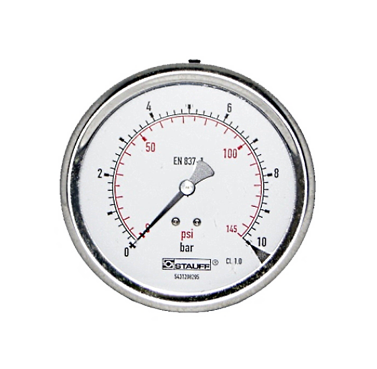
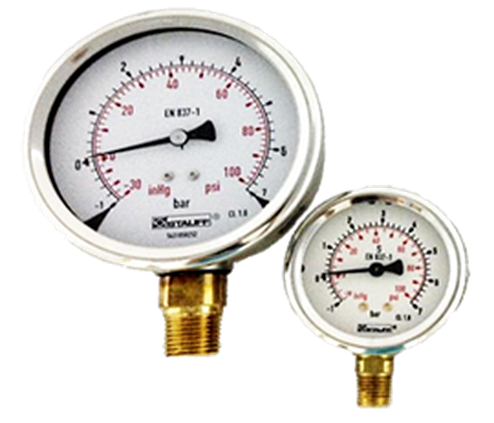
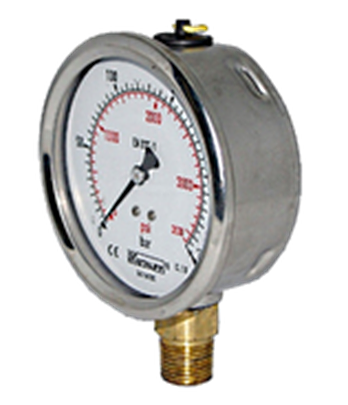

Pressure gauges for hydraulic lines, glycerine filled so the pointer does not chase the pump ripple. Stainless 1.4301 case, acrylic sight glass, copper-alloy wetted parts — available stem mount or panel mount, in five scale styles.
State working pressure, dial size, thread and mounting — quotes within 2 working hours.
| Standard | Built & tested to EN 837-1 |
|---|---|
| Dials | RFS 40 / 50 / 63 / 100 mm · STAUFF SPG 63 / 100 mm |
| Ranges | −1 bar to 1,000 bar |
| Accuracy | Class 1.6 (63 mm) · class 1.0 (100 mm) |
| Case | Stainless 1.4301 · acrylic sight glass |
| Fill | Glycerine |
| Temperature | Ambient −20…+60 °C · medium max +60 °C |
| Connections | G1/4 · G1/2 · 1/4″ NPT · 1/2″ NPT · 7/16-20 UNF |
The full range table, the seven-field order code and the CE rules are on this page, as printed in the catalogue.
| At a glance | 63 mm | 100 mm |
|---|---|---|
| Accuracy class | 1.6 | 1.0 |
| On 0–400 bar | ±6.4 bar | ±4.0 bar |
| Connections | G1/4 · NPT · UNF | G1/2 · NPT |
| Protection | IP65 (>16 bar) | IP65 |
| Range (bar) | Range (psi) | Order code | Working pressure (⅔ scale) |
|---|---|---|---|
| −1 … 1.5 | −14.5 … 21 | (-1)-(1,5) | Vacuum / low pressure |
| −1 … 3 | −14.5 … 43 | (-1)-00003 | Vacuum / suction |
| 0 … 10 | 0 … 145 | 00010 | ±7 bar |
| 0 … 16 | 0 … 232 | 00016 | ±11 bar |
| 0 … 25 | 0 … 362 | 00025 | ±17 bar |
| 0 … 40 | 0 … 580 | 00040 | ±27 bar |
| 0 … 60 | 0 … 870 | 00060 | ±40 bar |
| 0 … 100 | 0 … 1,450 | 00100 | ±67 bar |
| 0 … 160 | 0 … 2,320 | 00160 | ±107 bar |
| 0 … 250 | 0 … 3,625 | 00250 | ±167 bar |
| 0 … 400 | 0 … 5,801 | 00400 | ±267 bar |
| 0 … 600 | 0 … 8,702 | 00600 | ±400 bar |
| 0 … 680 | 0 … 9,862 | 00680 | ±453 bar |
| 0 … 700 | 0 … 10,152 | 00700 | ±467 bar |
| 0 … 1000 | 0 … 14,503 | 01000 | ±667 bar |
The last column is the two-thirds rule already worked out. Find your working pressure there and take the range on that row — that is the right one. Choosing too tight a range means the pointer works at the top of the scale all the time, and that is what wears out the movement.
Accuracy classes
| Dial size | Class | Tolerance | Example at 0–400 bar |
|---|---|---|---|
| 63 mm | 1.6 | ±1.6% full scale | ±6.4 bar |
| 100 mm | 1.0 | ±1.0% full scale | ±4.0 bar |
Ingress protection (IP)
| Gauge type | Rating | Condition |
|---|---|---|
| SPG 100 | IP65 | All ranges |
| SPG 063 | IP65 | Above 16 bar |
| SPG 063 | IP54 | 16 bar and below — because it has a pressure compensation opening |
IP65 = dust tight and protected against water jets. IP54 = dust protected and protected against splashing water. The difference is not build quality — a low-range gauge needs a pressure compensation opening, and that opening is what lowers the rating.
| Field | What it fixes |
|---|---|
| 1 — Series | SPG |
| 2 — Size | 063 or 100 |
| 3 — Range | Five digits, from the range table above |
| 4 — Scale style | 01 bar/psi (bar outside) · 02 bar only · 03 psi only · 05 psi/bar (psi outside) · 10 kPa/psi (kPa outside) |
| 5 — Mounting | S stem · P panel |
| 6 — Connection | B04 G1/4 · B08 G1/2 · N04 1/4″ NPT · N08 1/2″ NPT · U04 7/16-20 UNF |
| 7 — Accessory | none · U U-bolt · F front flange · R rear flange · UF U-bolt + flange · G rubber cap |
Stem mounting takes the connection out of the bottom — the gauge stands on its own pipework. Panel mounting takes it out of the back — the gauge sits in a cut-out. Both are chosen in field 5, and the mounting hardware in field 7.
| Full-scale value | Status | CE mark |
|---|---|---|
| <0.5 bar / <7.25 psi | Outside the PED | Must not carry one |
| 0.5–200 bar / 7.25–2,900 psi | Good Engineering Practice | Must not carry one |
| >200 bar / >2,900 psi | Conformity procedure | Receives CE |
When a buyer or QC asks “why is there no CE mark?” on an 0–160 bar gauge, the answer is the middle row: at that range CE marking is not permitted. This is the single most misunderstood point on this product.
| Feature | RFS | STAUFF SPG |
|---|---|---|
| Dial sizes | 40, 50, 63, 100 mm | 63, 100 mm |
| Accuracy | 1.6 at 63 mm; 1.0 at 100 mm | Same |
| Glycerine fill | On request | Filled as standard |
| Connections (63 mm) | G1/4, 1/2″ NPT | G1/4, 1/4″ NPT, 7/16-20 UNF |
| Standard ranges | 22 options | 15 options |
RFS has more dial sizes and more ranges; STAUFF comes glycerine filled from the factory. If the line pulses — and nearly every piston-pump line does — make sure what you order is filled, whichever brand you choose.
Piston-pump ripple keeps the pointer shaking. Use the glycerine-filled gauge — that is what the fill is for.
Choose the range so working pressure is two thirds of full scale, leaving spikes somewhere to go.
A gauge hanging off its pipe gets knocked. Use a U-bolt or a panel mount — field 7 of the part code.
Once the pointer no longer returns to zero, the movement has been overstretched — on this class of gauge replacement is normally the sensible answer, not recalibration. To protect a gauge from severe pulsation, fit a needle valve cracked barely open ahead of it.
| Straight in | Confirm first |
|---|---|
| Mineral hydraulic oil Gaseous media compatible with copper alloys | Water-glycol · seawater · ammonia · aggressive chemicals — the wetted parts are copper alloy, so these are not automatically covered |
Full ranges, dimensions and part numbers are in the catalogue, as printed; stock and price are not — send the list and we confirm both.
Put your normal working pressure at about two thirds of full scale. That leaves headroom for spikes without the pointer working at the top of its scale all the time — and the wrong range is the commonest reason a gauge dies early.
Because on most hydraulic ranges it must not have one. Under the Pressure Equipment Directive, a full-scale value between 0.5 and 200 bar falls under Good Engineering Practice and is specifically excluded from CE marking. Only above 200 bar does a gauge go through a conformity procedure and receive it.
The 100 mm. It is accuracy class 1.0 (±1.0% of full scale); the 63 mm is class 1.6. On a 0–400 bar range that is ±4.0 bar against ±6.4 bar.
It is glycerine, and it damps the pointer. Pressure in a hydraulic system is never truly steady — a piston pump delivers ripple — and a dry gauge responds by blurring the needle.
Hydraulic oil and gaseous media compatible with copper-based alloys. It does not automatically cover water-glycol, seawater, ammonia or aggressive chemicals — name the medium before ordering.
Ambient −20 to +60 °C, and the medium a maximum of +60 °C.
IP65 = dust tight and protected against water jets. IP54 = dust protected and protected against splashing water. The 63 mm at 16 bar and below is only IP54 because it has a pressure compensation opening.
Stem mounting takes the connection out of the bottom — the gauge stands on its own pipework. Panel mounting takes it out of the back — the gauge sits in a cut-out.
Yes — there are four alternatives to the standard: bar only, psi only, psi outside with bar inside, or kPa outside with psi inside. All through the scale field of the part number.
Yes, at an accuracy of 0.5% of full scale — better than either analogue class. They cost more.
Three causes: pulsation (use the glycerine-filled gauge), over-range spikes (choose the range so working pressure is two thirds of full scale), and mechanical abuse (use a U-bolt or panel mount).
On this class of gauge, replacement is normally the sensible answer. Once the pointer no longer returns to zero, the movement has been overstretched.
Our running stock is 63 mm and 100 mm, stem mount, bar/psi dual scale — held in our regional warehouses in Singapore and Malaysia, out within 24 hours of your PO; quotes within 2 working hours.
Related: STAUFF level gauges · test couplings · needle valves for gauge protection · about the STAUFF brand · all accessories · baca halaman ini dalam Bahasa Indonesia
