
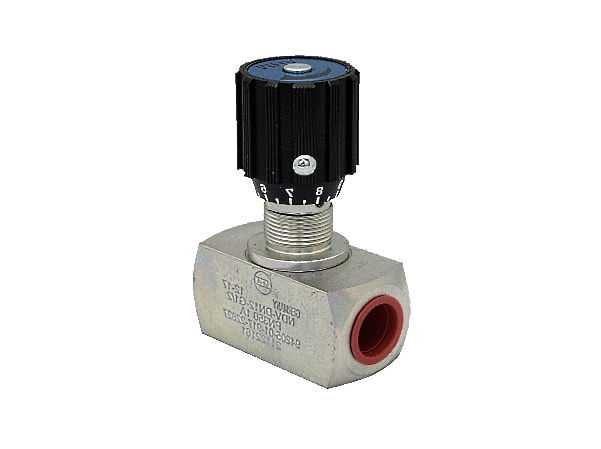

Multi-turn valves for metering, bleeding, gauge protection and instrument isolation. Three ranges cover 1/8″ to 2″ and 350 bar up to 10,000 psi (689 bar) — chosen on pressure, temperature, and whether the setting has to be repeatable.
State port & thread form, male×female or female×female, working pressure & temperature, and the duty — quotes within 2 working hours.
| Function | Metering · bleeding · gauge protection · instrument isolation |
|---|---|
| Range | 1/8″–2″ (DN6–DN40) |
| Pressure | 350 bar · 420 bar · 689 bar — by range |
| Body | SS316 · AISI 316 · steel |
| Stem | Tapered vee, non-rotating — HSME hard chrome plated |
| Packing | PTFE · chevron PTFE · Grafoil · NBR/FPM O-rings |
| Ports | NPT · BSPP (DIN ISO 228) · SAE J514 · tube fittings |
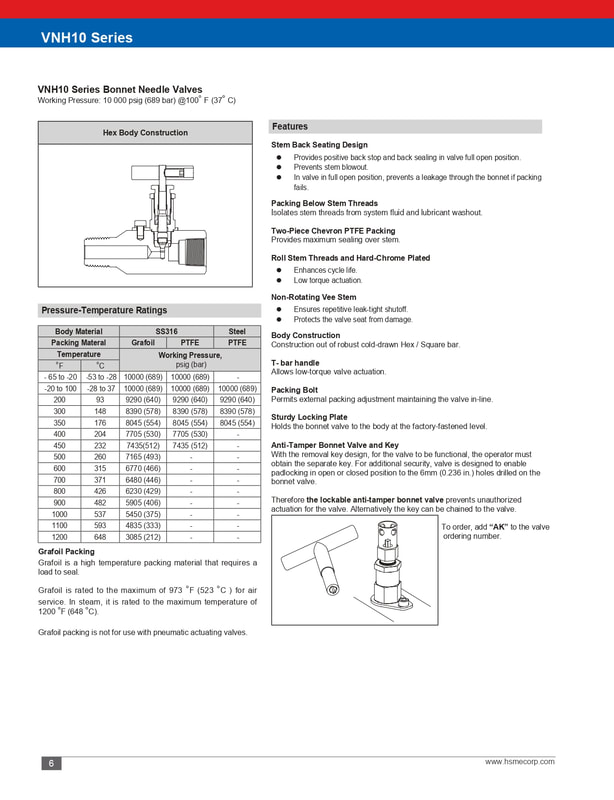
The pressure–temperature derating, dimension and orifice/Cv tables are on this page, as printed in the catalogue.
| At a glance | RFS | HSME | MHA |
|---|---|---|---|
| Pressure | 420 bar | 689 bar | 350 bar |
| Sizes | 1/4–1″ | 1/4–1″ | 1/8–2″ |
| Max temp | 150 °C | 648 °C | 100 °C |
| Scale | — | — | Graduated |
| Feature | RFS SS316 | HSME VNH10 | MHA NDV |
|---|---|---|---|
| Pressure | 6,000 psi / 420 bar | 10,000 psi / 689 bar | 350 bar (35 MPa) |
| Size range | 1/4″–1″ | 1/4″–1″ | DN6–DN40 (1/8″–2″) |
| Body | SS316 | SS316 or steel | Steel or AISI 316 |
| Handle | T-bar | T-bar | Graduated knurled knob |
| Temperature | −15…+150 °C | −53…+648 °C (Grafoil) | −20…+100 °C (−30 w/ code 4A) |
| Packing | PTFE + glass | Chevron PTFE / Grafoil | NBR / FPM |
| Panel mount | No | No | Yes (Pg thread) |
| Security option | No | Lockable AK bonnet | No |
| Test data published | 9,000 / 6,600 psi | Pressure–temp table | PN per size |
Nominal and test pressures
| Range | Nominal | Strength test | Seal test | Stated at |
|---|---|---|---|---|
| RFS SS316 | 6,000 psi / 420 bar | 9,000 psi (1.5×) | 6,600 psi (1.1×) | −15…+150 °C |
| HSME VNH10 | 10,000 psi / 689 bar | Per pressure–temp table | 100 °F (37 °C) | |
| MHA NDV | 350 bar / 35 MPa | PN per size & material | −20…+100 °C | |
| Temp (°C) | (°F) | Grafoil (SS316) | PTFE (SS316) | PTFE (steel) |
|---|---|---|---|---|
| −53…−28 | −65…−20 | 10,000 psi (689 bar) | 10,000 psi (689 bar) | — |
| −28…37 | −20…100 | 10,000 psi (689 bar) | 10,000 psi (689 bar) | 10,000 psi (689 bar) |
| 93 | 200 | 9,290 psi (640 bar) | 9,290 psi (640 bar) | 9,290 psi (640 bar) |
| 148 | 300 | 8,390 psi (578 bar) | 8,390 psi (578 bar) | 8,390 psi (578 bar) |
| 176 | 350 | 8,045 psi (554 bar) | 8,045 psi (554 bar) | 8,045 psi (554 bar) |
| 204 | 400 | 7,705 psi (530 bar) | 7,705 psi (530 bar) | — |
| 232 | 450 | 7,435 psi (512 bar) | 7,435 psi (512 bar) | — |
| 260 | 500 | 7,165 psi (493 bar) | — | — |
| 315 | 600 | 6,770 psi (466 bar) | — | — |
| 371 | 700 | 6,480 psi (446 bar) | — | — |
| 426 | 800 | 6,230 psi (429 bar) | — | — |
| 482 | 900 | 5,905 psi (406 bar) | — | — |
| 537 | 1000 | 5,450 psi (375 bar) | — | — |
| 593 | 1100 | 4,835 psi (333 bar) | — | — |
| 648 | 1200 | 3,085 psi (212 bar) | — | — |
“10,000 psi” holds to 37 °C, not everywhere. Note where the PTFE columns stop: 232 °C. Above that only Grafoil continues — to 648 °C, by which point the rating is down to 3,085 psi. Grafoil needs a load to seal and is not for pneumatically actuated valves.
| Body | Ports | Orifice | Cv | Application |
|---|---|---|---|---|
| VNH10A | 1/4″, 3/8″, 1/2″ NPT; 1/4″, 3/8″, 1/2″ OD tube | 3.2 mm (.126″) | 0.21 | Gauge protection, bleeding, instrument isolation |
| VNH10B | 3/4″ female NPT | 5.0 mm (.196″) | 0.6 | Metering a small actuator, drain/sample lines |
| VNH10C | 1″ female NPT | 5.0 mm (.196″) | 0.6 | Same flow as B, in a 1″ port |
Less will flow than the port suggests. The orifice is the governing figure: 3.2 mm / Cv 0.21 on bodies up to 1/2″, and 5.0 mm / Cv 0.6 at 3/4″ and 1″ — note that the 1″-ported VNH10C flows the same as the 3/4″. Size the valve on the orifice and the Cv, never on the thread.
| Type | BSPP port | NPT port | L (mm) | B (mm) | H1 (mm) | H2 (mm) | Weight |
|---|---|---|---|---|---|---|---|
| NDV-DN6 | G1/8 | 1/8″ NPT | 38 | 16 | 51 | 56 | 0.12 kg |
| NDV-DN8 | G1/4 | 1/4″ NPT | 48 | 25 | 65 | 71 | 0.25 kg |
| NDV-DN10 | G3/8 | 3/8″ NPT | 58 | 30 | 68 | 75 | 0.40 kg |
| NDV-DN12 | G1/2 | 1/2″ NPT | 68 | 35 | 82 | 92 | 0.60 kg |
| NDV-DN16 | G3/4 | 3/4″ NPT | 78 | 45 | 96 | 106 | 1.10 kg |
| NDV-DN20 | G1 | 1″ NPT | 108 | 50 | 121 | 134 | 2.40 kg |
| NDV-DN25 | G1¼ | 1¼″ NPT | 108 | 60 | 126 | 139 | 2.80 kg |
| NDV-DN30 | G1½ | 1½″ NPT | 108 | 70 | 131 | 144 | 3.50 kg |
| NDV-DN40 | G2 | 2″ NPT | 120 | 90 | 141 | 154 | 6.24 kg* |
*The 2″ NPT version: 6.30 kg. ⚠ DN is not the port size. An NDV-DN20 takes a G1 or 1″ NPT port — the DN figure is the bore. Read the port from the thread column when ordering.
RFS SS316 — dimensions (NPT female × female)
| Size | L (mm) | Port centre A (mm) | Height H (mm) | Handle W (mm) | Weight |
|---|---|---|---|---|---|
| 1/8″ | 51 | 29 | 86 | 51 | — |
| 1/4″ | 60 | 29 | 86 | 51 | 0.46 kg |
| 3/8″ | 60 | 29 | 86 | 51 | 0.46 kg |
| 1/2″ | 67 | 29 | 86 | 51 | 0.58 kg |
| 3/4″ | 73 | 32 | 96 | — | 0.58 kg |
| 1″ | 83 | 51 | 108 | 51 | — |
HSME VNH10: length 62–93.9 mm · hex 31.75 mm to 1/2″, 41–46 mm at 3/4″ and 1″ · open height 67.2–92.9 mm. Leave clearance above the valve — the stem rises up to 13 mm on the larger MHA bodies.
V valve · N needle · MF male×female (or FF) · S stainless · N NPT · 08 size (04=1/4″, 06=3/8″, 08=1/2″, 12=3/4″, 16=1″).
VNH10 series · A body (3.2 mm orifice) · F female · 8 = 1/2″ (sixteenths) · N NPT (T tube, MF male×female) · suffix AK = anti-tamper bonnet.
NDV type · DN12 bore · G1/2 port (read this, not the DN) · 1A material code.
MHA material codes
| Code | Body | Seals | Note |
|---|---|---|---|
| 1A | Steel | NBR | PN 350 bar |
| 18 | Steel | FPM (Viton) | PN 350 bar |
| 4A | AISI 316 | NBR | Rated down to −30 °C |
| 48 | AISI 316 | FPM (Viton) | PN 350 bar |
All four codes carry PN 350 bar at every size — what changes is the material and the seal. Code 4A is the only one that goes down to −30 °C.
The stem descends without turning on the seat — so the leak-tight shut-off repeats instead of changing each time.
In the fully open position the stem seats against a positive back stop — this is what stops the stem blowing out.
System fluid never washes the lubricant out of the stem threads.
The packing can be taken up from outside — on the HSME range with the valve still in the line.
A knurled knob turning over a graduated ring — the setting can be recorded and repeated.
Pg7–Pg29 conduit thread on the bonnet; panel thickness 4 mm at DN6 to 10 mm from DN20 up.
The stem rises up to 13 mm on the larger MHA bodies.
Particles carried through a small orifice will score the seat.
When threading it into the line — turning from the bonnet damages the packing.
BSPP needs a sealing face or bonded washer at the port.
The panel holds the valve, not the weight of the pipe.
Hand tight is enough on the seat.
Closing against flow wire-draws the seat.
Barely open is what damps the needle.
If the stem weeps, the valve is usually not finished: take up the packing bolt. On the HSME range that can be done with the valve still in the line and under pressure.
| Standard | Covers |
|---|---|
| GB/T 12224-2005 · JB/T 7747-2010 | Design and manufacture |
| GB/T 12252-2005 | Supply conditions |
| GB/T 13927-1992 | Testing |
Media: the RFS SS316 range is specified for general oil, gas and water; HSME is rated by its packing and wetted parts (SS316 with fluorocarbon lubricant); the MHA NDV is a hydraulic component and the seal choice matters — name the medium.


Full dimensions and part numbers are in the catalogues, as printed; stock and price are not — send the list and we confirm both.
Setting the speed of movement — set once, left at its position.
Getting air out of a circuit without breaking a joint.
Damping pressure spikes so the needle stops flickering — barely open.
Shutting off a transmitter or gauge for calibration.
Small controlled flows — the VNH10B/C bodies.
SS316 bodies for salt air and washdown.
Metering, not isolating. A long tapered vee stem seats in a small orifice on a fine thread, so one turn changes the flow only a little — which is what you want when you are setting a flow or a pressure. Typical duties: throttling a cylinder or motor, bleeding air, damping a gauge, taking a sample, isolating an instrument for calibration.
No. Closing it repeatedly against pressure and flow will wire-draw the seat. The right arrangement is to isolate with a ball valve and leave the needle valve at its setting. Hand tight on the seat is enough.
HSME VNH10: 10,000 psi (689 bar) up to 37 °C. RFS SS316: 6,000 psi (420 bar). MHA NDV: 350 bar (35 MPa) at every size. All three derate as temperature rises.
Because the rating is only true at that temperature. Steel and stainless lose strength as they heat up, and the packing has its own ceiling. The HSME table runs from 10,000 psi at 37 °C down to 3,085 psi at 648 °C.
PTFE is the standard. Grafoil is the high-temperature option — 523 °C in air and 648 °C in steam, where PTFE has stopped at 232 °C. Grafoil needs a load to seal and is not for use with pneumatically actuated valves.
Less than the port suggests. The orifice is the governing figure: 3.2 mm with a Cv of 0.21 on the HSME bodies up to 1/2″, and 5.0 mm with a Cv of 0.6 at 3/4″ and 1″. Size the valve on the orifice and the Cv, never on the thread.
No. On the MHA range the DN figure is the bore, not the port. DN20 takes a G1 or 1″ NPT port. Read the port from the thread column.
Only the MHA NDV, which runs to DN40 (2″) at 350 bar. The RFS and HSME ranges both stop at 1″.
Yes — the MHA NDV has a knurled knob turning over a graduated ring. On the RFS and HSME ranges, count turns from fully closed.
Yes on the HSME range: the lockable anti-tamper bonnet uses a removal key, with 6 mm holes for a padlock. Add the AK suffix — and it cannot be retrofitted.
Usually not. There is a packing bolt specifically so the packing can be taken up from outside — and on the HSME range that can be done with the valve still in the line.
On the HSME range the stem back-seats: in the fully open position it seats against a positive back stop. The packing itself sits below the stem threads, so the system fluid never washes the lubricant out.
Yes on the MHA NDV: the bonnet carries a Pg7–Pg29 conduit thread. The catalogue gives a maximum panel thickness per size, from 4 mm on the DN6 to 10 mm on the DN20 and above. Support the pipework separately.
The RFS SS316 range is specified for general oil, gas and water. The MHA NDV is a hydraulic component and the seal choice matters — name the medium and we pick it.
Our running stock is SS316 NPT bodies from 1/4″ to 1/2″, held in our regional warehouses in Singapore and Malaysia, out within 24 hours of your PO; quotes within 2 working hours.
Related: hydraulic ball valves · high pressure check valves · pressure gauges · about the MHA Zentgraf brand · all high pressure valves · baca halaman ini dalam Bahasa Indonesia