
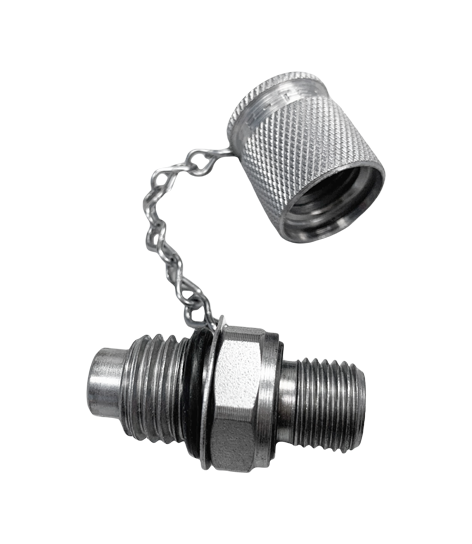

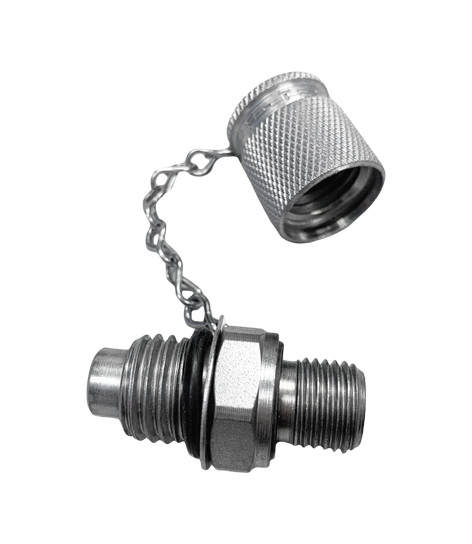
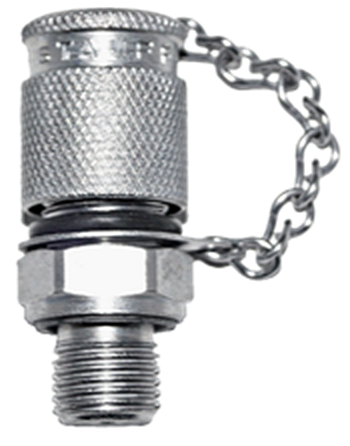
Permanent test points in a hydraulic line: fit a gauge, vent air, or draw an oil sample without tools and without stopping the system. One portable instrument serves many points — and every point stays capped and clean between uses.
State the series (20 or 15), circuit connection, material and seal — quotes within 2 working hours.
| Series | Test 20 · Test 15 |
|---|---|
| Connection standard | ISO 15171-2 — the same on both series |
| Working pressure | 630 bar / 9,137 psi (static, sealed) |
| Live connection | 400 bar / 5,801 psi maximum |
| Body | W3 zinc/nickel steel · W4 AISI 303 · W5 AISI 316Ti |
| Seals | B NBR · V FKM (Viton) · E EPDM |
| Ball | Stainless — on every version, including W3 bodies |
| Cap | Self-locking metal, chained to the body |
The type list per series, material grades and seal ranges are on this page, as printed in the catalogue.
| At a glance | Test 20 | Test 15 |
|---|---|---|
| Couplings | SMK, SKK, SSK | SMK, SSK |
| Valve | Ball & piston | Piston |
| Adaptors | SAD/SMA/SMD-20 | SAD/SMA/SMD-15 |
| Parameter | Value | Notes |
|---|---|---|
| Max working pressure | 630 bar / 9,137 psi | Static, in the sealed condition |
| Connection under pressure | 400 bar / 5,801 psi | Dynamic limit — this is the figure that governs on site |
| Type G & Type K | Whichever is lower | The fitting manufacturer's rating also applies — take the lower |
The 400 bar limit is deliberately below the 630 bar. 630 bar is what the coupling holds while sealed; 400 bar is the limit for making or breaking a connection on a live system. If your system runs above 400 bar and you need a live reading, isolate with a needle valve or depressurise first.
| Condition | Action |
|---|---|
| System ≤400 bar, live connection required | Proceed — the coupling is rated 630 bar |
| System >400 bar, live reading needed | Isolate via a needle valve, or depressurise |
| Type G or Type K connections | Cross-reference the fitting maker's rating — use the lower limit |
| Part number | Connection style | Valve type | Availability |
|---|---|---|---|
| SMK-20 | Male threaded stud | Ball check | Standard stock |
| SMK-20 Type G | Straight 24° fitting | Ball check + piston | Available |
| SMK-20 Type K | 24° taper / O-ring (DKO) | Ball check | Available |
| SMK-20-JIC Type K | 37° JIC | Ball check | Available |
| SMK-20-JIC Type G | Straight 37° JIC | Ball check | Available |
| SMK-20 Type ORFS | O-ring face seal | Ball check | Available |
| SSK-20 | Bulkhead (panel mount) | Ball check | Available |
| SKK-20 | Male stud / 24° taper | Piston valve | Available |
| SKK-20 Type K | 24° taper / O-ring | Piston valve | Available |
Test 15 series
| Part number | Connection style | Valve type |
|---|---|---|
| SMK-15 family | Male stud / 24° / DKO | Piston valve |
| SSK-15 | Bulkhead | Piston valve |
Ancillary components
| Part | Function |
|---|---|
| SGV-JIC Type FM | Swivel run tee — retrofits into an existing 37° JIC joint and adds a test point with no new port to drill |
| SAD-20 / SAD-15 | Test adaptor — connects test points to instruments |
| SMA / SMD-20 and -15 | Gauge adaptor — attaches a gauge directly to a test point |
Ball check or piston valve is usually decided by the connection. Ball check covers most of the range — including all JIC, ORFS and the Test 20 bulkheads. Piston valve covers the SKK-20 and the SMK-15 family.
| Code | Material | Specification | Standard use |
|---|---|---|---|
| W3 | Steel, zinc/nickel plated | Standard | General hydraulics; enclosed machinery |
| W4 | Stainless | 1.4305 / AISI 303 | Washdown; light corrosion |
| W5 | Stainless | 1.4571 / AISI 316Ti | Marine, offshore, chemical service |
| Code | Seal | Temperature range | Application |
|---|---|---|---|
| B | NBR (Buna-N) | −20…+100 °C | Standard mineral hydraulic oil |
| V | FKM (Viton) | −20…+200 °C | Hot oil; aggressive fluids |
| E | EPDM | −40…+150 °C | Brake fluid — named specifically by STAUFF |
⚠ The internal seals are FKM even on the standard NBR build — STAUFF states this on its own datasheet. So a coupling coded B still contains FKM internal components. The ball is stainless on every version including W3 bodies, and the vibration safety O-ring is NBR on every build including the Viton ones.
FKM — even on the standard NBR build.
Stainless on every version, including the W3 steel bodies.
NBR — stops the protective cap self-loosening under machine vibration.
Holds the ball on its seat — this is what makes the port self-closing.
Seals the coupling into its circuit port.
Closed with a threaded nipple, not crimped.
The body is closed with a threaded nipple in an automated process — it is not crimped shut after the valve components and seals go in. The protective cap is self-locking and chained to the body; hexagonal steel or plastic variants are available on the SMK-20 range, and colour marking rings across both Test 20 and Test 15, in steel and stainless.
| Function | What connects | The advantage |
|---|---|---|
| Pressure monitoring | Gauge, or a test hose via an adaptor | One portable instrument serves many points |
| Venting | Hose to a container, or opened directly | A release point that was designed — not a cracked fitting |
| Fluid sampling | Sampling hose / bottle adaptor | A sample representative of the system, on a live flowing line |
On oil sampling: a sample drawn from a capped test point on a live, flowing line is representative of the system. A sample taken by cracking a joint into a jar tells you mostly about the joint — which is why contamination results so often mislead.
A male threaded stud coupling screws straight in — done.
The SGV-JIC Type FM swivel run tee goes into an existing 37° JIC joint and adds a test point without moving anything.
An SSK-20 or SSK-15 bulkhead passes through the panel plate.
STAUFF's own framing: test couplings are either designed in from the start, or added later when retrofitting or upgrading. Mark the points with colour rings now and the next technician does not have to guess which line is which.
Full dimensions and part numbers are in the catalogue, as printed; stock and price are not — send the list and we confirm both.
Yes, up to 400 bar / 5,801 psi. That is the catalogue limit for making or breaking a connection on a live system, and it is lower than the coupling's 630 bar working pressure on purpose.
No. The ball is held on its seat by a spring, and the mating hose or adaptor only pushes it off that seat after it has itself sealed. Disconnecting reverses the sequence, so the port is closed before the connection breaks.
No. The connection is hand-made, without tools, which is the point of a designed test port.
The two sizes in the range, each with its own family of couplings, bulkheads and adaptors: SMK-20, SKK-20, SSK-20, SAD-20, SMA-20, SMD-20 against SMK-15, SSK-15, SAD-15, SMA-15, SMD-15. What matters in practice is that hoses and adaptors have to match the series.
Ball check covers most of the range and is the usual choice — including all JIC and ORFS connections and the Test 20 bulkheads. Piston valve covers the SKK-20 and the SMK-15 family. In practice the decision is made for you by which connection you need.
Whatever is already there. A male threaded stud into a spare port, a straight 24° fitting (Type G), a 24° taper with O-ring / DKO (Type K), a 37° JIC, an ORFS face seal, or a bulkhead through a panel.
W3 steel with zinc/nickel plating is the standard, right for enclosed machinery. For corrosion duty: W4 (1.4305 / AISI 303) for washdown and light exposure, and W5 (1.4571 / AISI 316Ti) for marine, offshore and chemical service.
B, NBR (−20…+100 °C) for ordinary mineral hydraulic oil. V, FKM (Viton) (−20…+200 °C) for hot oil and more aggressive fluids. E, EPDM (−40…+150 °C), which STAUFF names specifically for brake fluid.
No, and this is worth knowing. STAUFF states on its own datasheet that the internal seal types are made of FKM even on the standard NBR build.
A vibration safety O-ring, in NBR, fitted specifically to prevent the protective cap self-loosening under machine vibration. The cap is also self-locking and chained to the body.
Yes, and it is one of the better reasons to fit them. A sample drawn from a capped test point on a live, flowing line is representative of the system; a sample taken by cracking a joint into a jar tells you mostly about the joint.
Yes. Where there is a spare port, a male threaded stud coupling screws straight in. Where there is not, the SGV-JIC Type FM swivel run tee goes into an existing 37° JIC joint and adds a test point — no new port to drill and tap.
Our running items are SMK-20 male threaded stud couplings in W3 steel with NBR seals, plus matching test hoses and gauge adaptors — held in our regional warehouses in Singapore and Malaysia, out within 24 hours of your PO.
Related: pressure gauges · STAUFF level gauges · quick release couplings · about the STAUFF brand · all accessories · baca halaman ini dalam Bahasa Indonesia
