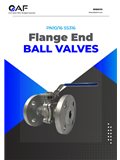
Flanged quarter-turn ball valves in six variants — ANSI Class 150 and 300, JIS 10K and PN10/16, in SS316 or cast carbon steel A216 WCB — plus a wafer type. Each is built to its own design standard, and that standard is what decides whether the valve bolts to your pipework. This page exists to get you to the right one.
DN15 to DN150 across the range — the lower limit varies by variant.
ANSI 150 · ANSI 300 · JIS 10K · PN10/16 — not interchangeable.
SS316 · cast steel A216 WCB with 304 trim.
Six flanged, one wafer type — each with its bill of materials, dimensions and test pressures.
Six carry flanges of their own. The seventh is a wafer body that bolts between yours. Each has its own page with the full bill of materials, every dimension and its test pressures.
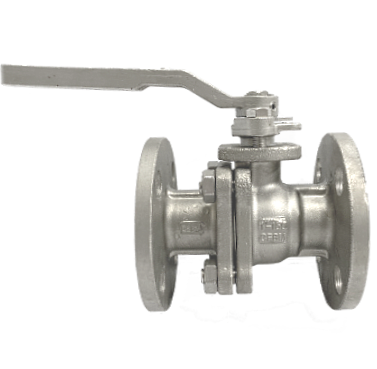
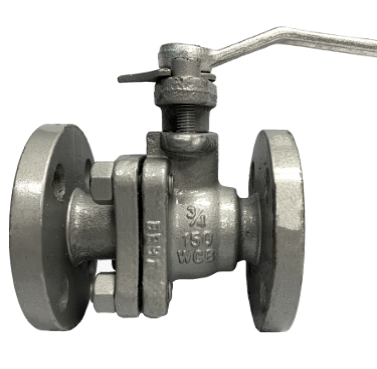
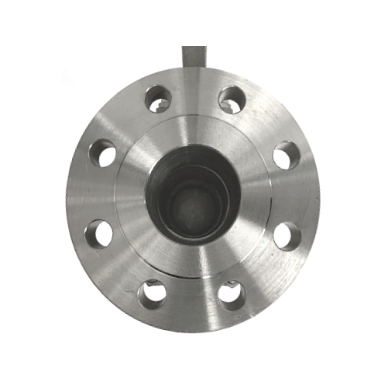
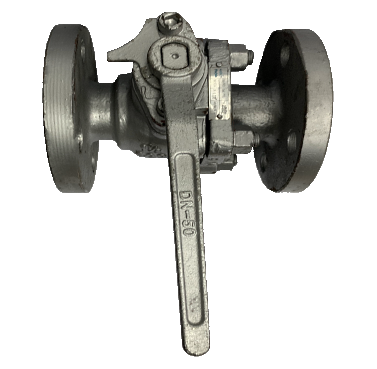
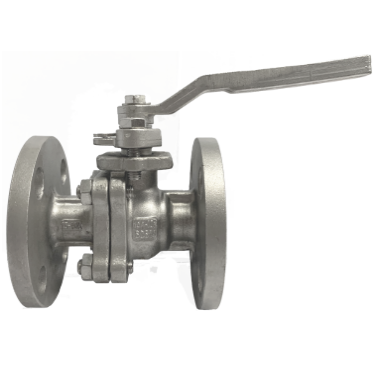
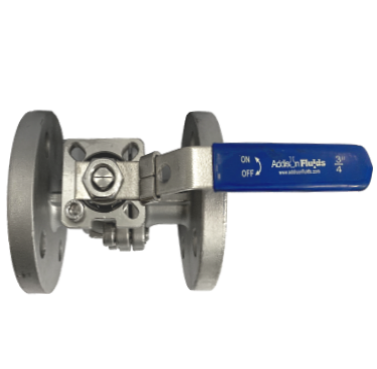
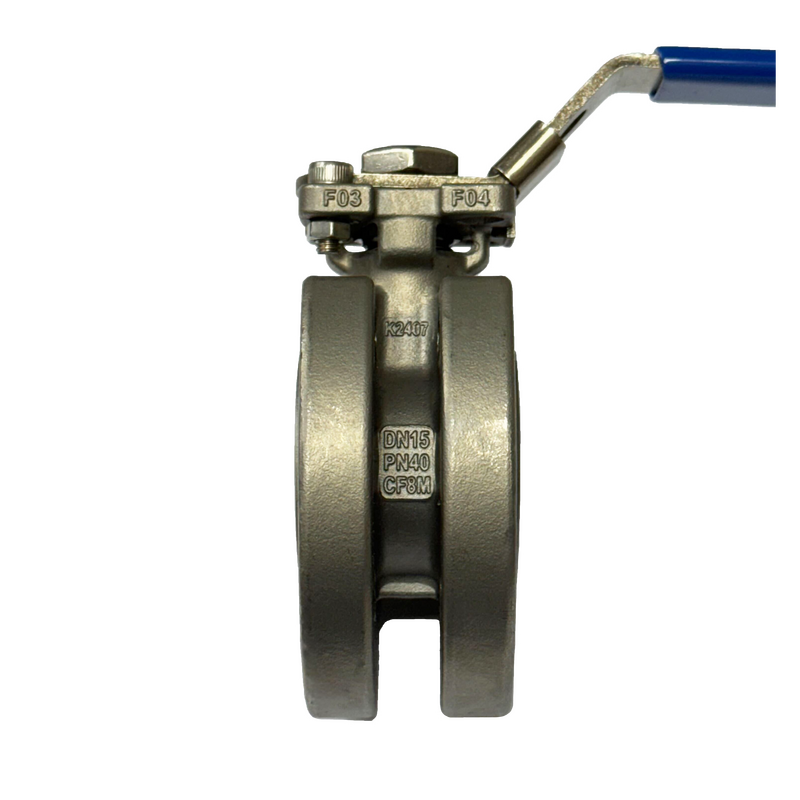
A flange that does not match is a valve you cannot fit.
A flange end ball valve does the same job as a threaded ball valve — a quarter-turn shut-off with a drilled ball — but it bolts into the line through a pair of flanges rather than screwing in. That buys you three things: it goes to larger sizes than a threaded body sensibly can, it comes out of the line without cutting or unscrewing pipework, and it is the normal arrangement on plant where valves are expected to be removed for service.
It also introduces the one constraint that governs everything on this page. The flange has to match the flange it bolts to — the same bolt circle, the same number of holes, the same hole diameter, the same raised face. That is set by the flange standard, and the four here are not interchangeable. An ANSI 150 valve will not bolt to a JIS 10K flange, and neither will bolt to a PN16 one.
ANSI 150 and JIS 10K are close in pressure — both around 1.6 to 2 MPa — but their bolt circles differ, so they do not mate. Measure or check the existing flange before ordering.
API 608, ANSI B16.34, API 6D, JIS B2071 and EN 1983 all appear across the six. If your specification names one of those, it names the variant.
The body is A216 WCB cast carbon steel and the ball and stem are 304, not 316. Corrosion resistance is well below the SS316 variants.
Shell, seat and gas-tightness — and they scale with class: 3.0 MPa shell at Class 150 against 7.8 MPa at Class 300.
For 1/8″ to 4″ screwed or weld-end valves, see ball valves — eight variants including three-way L and T-port.
Flange standard first, then material. That is the order the decision happens in.
| Variant | Flange | Size | Body material | Trim | Shell test | Choose it when |
|---|---|---|---|---|---|---|
| ANSI 150 SS316 | ANSI 150# | 1/2″–6″ | SS316 | SS316 | 2.4 MPa | The default for corrosive or clean-fluid duty on ANSI pipework. All-stainless, widest size range. |
| ANSI 150 cast steel | ANSI 150# | 3/4″–6″ | A216 WCB | 304 | 3.0 MPa | Non-corrosive duty on ANSI pipework where cost matters. Carbon steel body, 304 trim — not a stainless valve. |
| ANSI 300 SS316 | ANSI 300# | 1/2″–6″ | SS316 | SS316 | 6.0 MPa | Higher pressure on ANSI pipework, in stainless. Built to API 6D. |
| ANSI 300 cast steel | ANSI 300# | 1½″–6″ | A216 WCB | 304 | 7.8 MPa | The highest shell test in the range. ⚠ But its published temperature ceiling is 100 °C, not 150. |
| JIS 10K SS316 | JIS 10K | 1/2″–6″ | SS316 | SS316 | 3.0 MPa | Japanese-standard pipework. Will not bolt to ANSI even though the pressure is similar. Built to JIS B2071. |
| PN10/16 SS316 | PN10/16 | 3/4″–6″ | SS316 | SS316 | 2.4 MPa | European pipework. 16 bar nominal, built to EN 1983 with EN 1092-1 flanges. |
Four incompatible flange standards sit in this table. ANSI 150, JIS 10K and PN10/16 are all around 1.6–2 MPa and none of them bolts to another. Choosing on pressure alone is how the wrong valve gets ordered.
Both cast-steel variants have an A216 WCB body with 304 ball and stem. The four SS316 variants are stainless throughout. If the fluid or the environment is at all aggressive, that is the whole decision.
Every other variant here states −29 °C to 150 °C. We publish it as the manufacturer does and flag it — if you need 150 °C at Class 300, ask us to confirm before ordering.
And it doubles between Class 150 and Class 300. It is a manufacturing proof test, not a working pressure — do not design to it.
ANSI 150 cast steel and PN10/16 begin at 3/4″, and ANSI 300 cast steel begins at 1½″. Below those, use an SS316 variant or a threaded valve.
A flange end ball valve carries its own two flanges, so at 4″ it needs roughly 394 mm of pipe. If the gap in your run is smaller than that, the PN16/PN40 wafer type puts the same internals into 152 mm.
If your specification names a standard, this table names the valve. On a flanged valve the standards are not paperwork — they are the dimensions. The design standard sets the construction and testing, the face-to-face standard sets the length between flange faces so the valve fits the gap in the pipe run, and the flange standard sets the drilling. All three have to be right.
| Variant | Design and manufacture | Face-to-face | Flange ends |
|---|---|---|---|
| ANSI 150 cast steel | API 608 | ASME B16.10 | Wall thickness to ASME B16.34 |
| ANSI 150 SS316 | ANSI B16.34 | GB/T 12221 | GB/T 9113.1 |
| ANSI 300 cast steel | API 608 | ASME B16.10 | Wall thickness to ASME B16.34 |
| ANSI 300 SS316 | API 6D | ASME B16.10 | ANSI B16.5 |
| JIS 10K SS316 | JIS B2071 | JIS B2002 | JIS B2220 |
| PN10/16 SS316 | EN 1983 | EN 558 & S15 | EN 1092-1 |
For flanged and threaded metal valves, and it is what both cast-steel variants are built to. If a specification says “ball valve to API 608”, those are the two.
A heavier, pipeline-oriented specification than API 608. Only the ANSI 300 SS316 is built to it, and it is the one to quote on pipeline work.
It is the design standard for the ANSI 150 SS316 valve, and the wall thickness standard for both cast-steel valves. Same document, different scope — worth knowing if a specification cites it without saying which.
GB/T 9113.1 and GB/T 12221. GB/T 9113.1 flanges are dimensionally aligned with ANSI 150, but if your specification insists on ASME B16.5 flanges specifically, tell us and we will confirm before quoting.
It is column L on every variant page. Measure the gap in the run before ordering, especially on a replacement.
Four variants are stainless throughout. Two are not stainless at all — and the cast-steel pair is materially different in a way the name does not make obvious, so it is worth setting out part by part.
| Part | SS316 variants | Cast steel variants |
|---|---|---|
| Body | SS316 and CF8M | ASTM A216 WCB cast carbon steel |
| Ball | SS316 | ASTM A240 304 |
| Stem | SS316 | ASTM A182 F304 |
| Seat | PTFE | PTFE |
| Packing | PTFE | Flexible graphite |
| Gasket | PTFE | SS304 + graphite |
| Bolting | SS304 | A193 B7 / A194 2H alloy steel |
| Handle | SS201 | A216 WCB, zinc plated |
| Anti-static device | Not listed | SS304 — fitted |
Body in A216 WCB, ball and stem in 304. It is a perfectly good valve for water, air, oil and general non-corrosive service — and it is not a substitute for SS316 where corrosion is the reason stainless was specified.
Flexible graphite packing and a graphite-faced gasket take more heat than PTFE and behave better under thermal cycling. On hot, clean, non-corrosive duty that is a real point in its favour.
A ball turning on PTFE seats is electrically isolated; the SS304 anti-static device bonds it back to the body. It matters on hydrocarbons. The SS316 parts lists here do not include one — ask us if you need it.
A193 B7 studs with A194 2H nuts are alloy-steel pressure bolting; the SS316 variants use SS304 fasteners, which are more corrosion-resistant but lower strength.
Both families seal on PTFE, which is why every variant tops out around 150 °C regardless of what the body is made of.
Proof tests from the factory — not working pressures. The shell test proves the body casting, the seat test proves the seal against the ball, and the gas-tightness test proves it holds low-pressure gas. Do not design to them: they are well above the working rating, and a valve is not intended to operate there.
| Variant | Nominal | Shell / body test | Seat / tightness | Gas tightness | Max working temp. |
|---|---|---|---|---|---|
| ANSI 150 SS316 | Class 150 | 2.4 MPa | 1.8 MPa | 0.6 MPa | −29 to 150 °C |
| ANSI 150 cast steel | Class 150 | 3.0 MPa | 2.2 MPa | 0.6 MPa | −29 to 150 °C |
| ANSI 300 SS316 | Class 300 | 6.0 MPa | 4.4 MPa | 0.6 MPa | −29 to 150 °C |
| ANSI 300 cast steel | Class 300 | 7.8 MPa | 5.6 MPa | 0.6 MPa | ⚠ 100 °C |
| JIS 10K SS316 | JIS 10K | 3.0 MPa | 2.2 MPa | 0.6 MPa | −29 to 150 °C |
| PN10/16 SS316 | 1.6 MPa | 2.4 MPa | — | 0.6 MPa | −29 to 150 °C |
As the catalogue states; the other five variants state −29 °C to 150 °C. If you need Class 300 at 150 °C, use the ANSI 300 SS316, which states the full range.
Cast steel 3.0/2.2 MPa against SS316 2.4/1.8 MPa — same class, different figures, because the two families come from different catalogue sources with different test regimes. It does not mean the cast-steel valve has a higher working rating.
The one figure that does not change with class or material — it is a low-pressure seal check, not a strength test.
2.4 → 6.0 MPa in SS316, 3.0 → 7.8 MPa in cast steel. That is the measure of how much heavier a Class 300 body is.
1.6 MPa — that is what PN16 means — and its shell test is 2.4 MPa. It publishes no separate seat test figure.
The range as a whole. Per-variant figures are on the six pages.
| Item | Detail |
|---|---|
| Size range | 1/2″ to 6″ (DN15 to DN150) across the range — the lower limit varies by variant, see the table |
| Flange standards | ANSI 150# · ANSI 300# · JIS 10K · PN10/16 — not interchangeable |
| Body materials | Stainless steel SS316 (and CF8M where cast) · cast carbon steel ASTM A216 WCB |
| Trim | SS316 ball and stem on the stainless variants · ASTM A240 304 / A182 F304 on the cast-steel variants |
| Design standards | API 608 · API 6D · ANSI B16.34 · JIS B2071 · EN 1983 — by variant |
| Working temperature | −29 °C to 150 °C, except ANSI 300 cast steel at 100 °C |
| Seat | PTFE throughout — which is what sets the temperature ceiling |
| Packing | PTFE on the stainless variants · flexible graphite on cast steel |
| Shell test | 2.4 to 7.8 MPa depending on class and material |
| Operation | Quarter turn manual lever |
| Not on this page | Threaded and weld-end ball valves, 1/8″ to 4″ — see ball valves. Higher classes: high pressure ball valves |
| Stock | Singapore and Malaysia warehouses — out within 24 hours |
Most of the work is the gasket and the bolt sequence. A flanged valve is easier to remove than a threaded one and slightly fussier to fit, because you are making two gasketed joints rather than two threads. The valve itself needs no sealant.
Count the bolt holes and measure the bolt circle against the mating flange. ANSI 150, JIS 10K and PN16 look similar and do not mate.
Column L on the variant pages. On a replacement, measure the valve coming out.
And check the raised faces are undamaged — a scored face will weep however hard it is bolted.
A 6″ Class 300 cast-steel valve is 99 kg. It must not hang on the flanges.
The gasket has to match the flange drilling and the raised face, not just the bore.
Working up to final torque. Bolting one side down before the other cocks the joint and it will leak.
The body is not a puller, and a distorted body can bind the ball.
It needs a clear 90° sweep, and on the larger sizes the lever is long. A quarter turn each way before commissioning confirms the ball is free.
Six manufacturer catalogues, one per flanged variant. All AF Hydro PDFs, as printed.
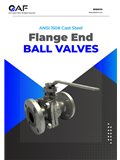
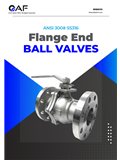
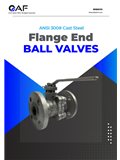
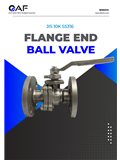
⚠ The seventh has no separate catalogue. The PN16/PN40 wafer type ball valve is not published as its own PDF — the data is on its page. Ask us if you need the factory sheet.
Dimensions and part numbers per variant are in the catalogues, as printed; stock and price are not — send us the list and we will confirm both.
The catalogues are thorough on dimensions and test pressures, and silent on a few things people ask about regularly. We say which — we do not guess, and we do not borrow figures from another variant.
| Not published | What it means for you |
|---|---|
| Weights — some or all | PN10/16 publishes no weights at all; ANSI 300 SS316 omits most of them; ANSI 150 SS316 and JIS 10K omit the 1/2″. For support or lifting calculations, tell us the size and we will weigh a stocked unit. |
| Height and lever length | Not published on PN10/16 or the wafer type. That is the swing room the valve needs in the run — ask before you place it in a tight space or under a platform. |
| Flow coefficient Cv | Not published on any variant. All are full bore, so use the nominal bore as the basis for a calculation and come to us if the figure is critical. |
| ISO 5211 actuator pad | Only the wafer type publishes one (F03/F04). For all six flanged variants, confirm actuator fit before ordering — do not assume a top plate. |
| Fire-safe certification | The designs are API 608, API 6D, ANSI B16.34, JIS B2071 or EN 1983 depending on the variant — but the seats are soft-seated PTFE and we make no fire-safe claim across this range. If your specification demands it, say so before ordering. |
| Anti-static device | Both cast steel variants fit one (SS304), but their parts lists do not carry it as an item. The SS316 variants do not mention it at all. On hydrocarbons this matters — ask, and we will confirm with the factory. |
| Lockable handle (LOTO) | Not a published option. Raise it at quotation — it is a factory question and awkward to retrofit once the valve is installed. |
| EN 10204 3.1 certificates | Available on request; the castings carry heat numbers. Ask with the order, not after the goods arrive. |
⚠ One published figure that regularly surprises people: ANSI 300 cast steel publishes a 100 °C temperature limit — not the 150 °C of the other five — despite having the highest shell test in the range at 7.8 MPa. That is as printed, not a typo of ours.
A quarter-turn ball valve that bolts into the line through a pair of flanges rather than screwing in. That lets it go to larger sizes than a threaded body sensibly can, come out of the line without cutting or unscrewing pipework, and it is the normal arrangement on plant where valves are expected to be removed for service.
Because the flange has to match the flange it bolts to — the same bolt circle, number of holes, hole diameter and raised face. ANSI 150, JIS 10K and PN10/16 are all around 1.6 to 2 MPa and none of them bolts to another. Choosing on pressure alone is how the wrong valve gets ordered.
Six flanged variants — ANSI Class 150 and 300 in SS316 or cast steel A216 WCB, JIS 10K SS316 and PN10/16 SS316 — plus a PN16/PN40 SS316 wafer type that bolts between your own flanges. Seven pages in all.
No. The body is ASTM A216 WCB cast carbon steel and the ball and stem are 304, not 316. It is a perfectly good valve for water, air, oil and general non-corrosive service — and it is not a substitute for SS316 where corrosion is the reason stainless was specified.
API 608, API 6D, ANSI B16.34, JIS B2071 and EN 1983 all appear across the six. If your specification names one of those, it names the variant — the full table is on this page.
No. The shell test is a manufacturing proof test that proves the body casting — roughly 1.5× the class rating, and well above the working pressure. The figures run 2.4 to 7.8 MPa depending on class and material. Do not design to them.
Because that is how the catalogue prints it. The other five variants state −29 to 150 °C; this one states 100 °C. We publish it as the manufacturer does and flag it — if you need 150 °C at Class 300, use the ANSI 300 SS316, which states the full range, or ask us to confirm first.
A flange end ball valve carries its own two flanges, so at 4″ it needs roughly 394 mm of pipe. If the gap is smaller, the PN16/PN40 SS316 wafer type puts the same ball-and-PTFE-seat internals into 152 mm by bolting between your flanges — and it is the only one here with a published ISO 5211 actuator pad.
For 1/8″ to 4″ screwed or weld-end valves, see the ball valves page — eight variants including three-way L-port and T-port.
Held in our Singapore and Malaysia warehouses, out within 24 hours of your PO; quotes within 2 working hours.
Related: threaded ball valves (1/8″–4″, eight variants) · flanges · all low pressure valves.
baca halaman ini dalam Bahasa Indonesia
