A flanged quarter-turn ball valve with ANSI 150# flanges, 3/4″ to 6″ (DN20 to DN150), with a cast carbon steel ASTM A216 WCB body and 304 trim. Built to API 608, face-to-face ASME B16.10. Flexible graphite packing and an SS304 anti-static device. Shell tested at 3.0 MPa, −29 °C to 150 °C.
State the size, the flange standard and the fluid — we confirm whether cast steel is appropriate. Quotes within 2 working hours.
| Flange standard | ANSI 150# — must match your pipework |
|---|---|
| Range | 3/4″ to 6″ (DN20–DN150) |
| Design | API 608 |
| Face-to-face | ASME B16.10 |
| Flange ends | Wall thickness to ASME B16.34 |
| Body | Cast carbon steel ASTM A216 WCB |
| Trim | A240 304 ball, A182 F304 stem |
| Max temperature | −29 °C to 150 °C |
The nine-size dimension table with part numbers, the 16-item bill of materials and the test pressures are all on this page, as printed in the catalogue.
Built to API 608, with ANSI 150# flanges.
A quarter-turn ball valve that bolts into the line through ANSI 150# flanges, in 3/4″ to 6″ (DN20 to DN150). The body is cast carbon steel ASTM A216 WCB, designed and manufactured to API 608, with face-to-face to ASME B16.10 and wall thickness to ASME B16.34.
This is not a stainless valve, and the name does not make that obvious. The ball and stem are 304 — A240 304 and A182 F304 — not 316, and the body is carbon steel. For water, air, oil and general non-corrosive service it is a perfectly good valve and a cheaper one. For anything aggressive, the SS316 variant on the same flange is the answer.
A216 WCB body, A240 304 ball, A182 F304 stem. Corrosion resistance is well below the SS316 variants — if corrosion is the reason stainless was specified, this is not the substitute.
Flexible graphite packing (item 18) and a graphite-faced gasket (17a) take more heat than PTFE and behave better under thermal cycling. On hot, clean, non-corrosive duty that is a real point in its favour.
Item 24, SS304. This is one of only two flange end variants that list one — the four SS316 variants do not. A ball turning on PTFE seats is electrically isolated; this bonds it back to the body, and it matters on hydrocarbons.
A193 B7 studs with A194 2H nuts — alloy-steel pressure bolting. The SS316 variants use SS304 fasteners: more corrosion-resistant, lower strength.
3/4″ to 6″, nine sizes. If you need 1/2″ on an ANSI 150 flange, use the SS316 variant, which starts there.
Higher than the Class 150 SS316 variant (2.4 and 1.8 MPa) — same class, different figures, because the catalogue sources differ. It does not mean a higher working rating.
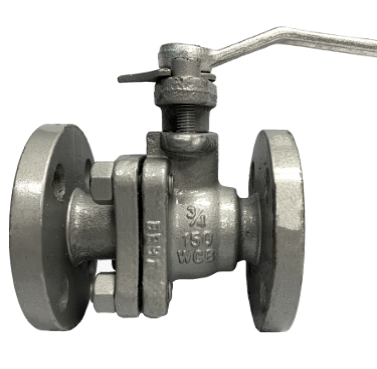
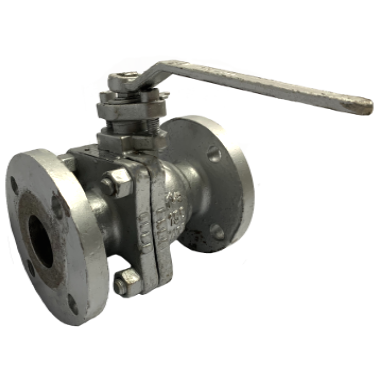
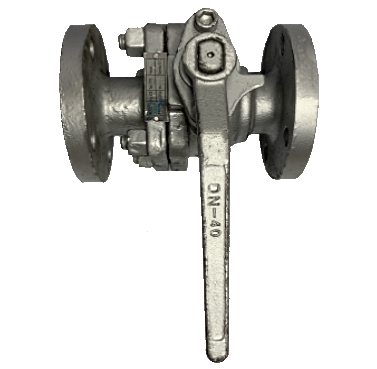
All photographs of the stocked item, not renders.
Cast carbon steel body, painted. The shape is heavier and more ribbed than a stainless body — that is the A216 WCB casting.
Raised face and bolt holes. This is the face that has to match your pipework — bolt circle D1 and hole pattern n-d in the size table.
Zinc-plated A216 WCB lever with the packing gland beneath it — items 26 and 10 on the parts list. The packing inside is flexible graphite, not PTFE.
Everything that goes on a purchase order.
| Item | Detail |
|---|---|
| Size range | 3/4″ to 6″ (DN20 to DN150) |
| Flange standard | ANSI 150# — not interchangeable with ANSI, JIS or PN alternatives |
| Design and manufacture | API 608 |
| Face-to-face dimensions | ASME B16.10 |
| Flange ends | Wall thickness to ASME B16.34 |
| Body material | Cast carbon steel ASTM A216 WCB |
| Trim | ASTM A240 304 ball, A182 F304 stem |
| Seat | PTFE — which sets the temperature ceiling |
| Packing | Flexible graphite |
| Shell test | 3.0 MPa |
| Seat test | 2.2 MPa |
| Gas tightness test | 0.6 MPa |
| Maximum working temperature | −29 °C to 150 °C |
| Operation | Quarter turn manual lever |
| Stock | Singapore and Malaysia warehouses — out within 24 hours |
Nine sizes, dimensions in millimetres. The two figures that decide whether the valve fits are face-to-face L and the bolt circle D1 with its hole pattern.
| Size | Part no | Flange OD D | Bolt circle D1 | Raised face D2 | Flange thk b | Face-to-face L | Bolts n-d | Weight (kg) |
|---|---|---|---|---|---|---|---|---|
| 3/4″ | VL-CS-B2-F-150-12 | 98 | 70 | 43 | 11.5 | 114 | 4-16 | 2.7 |
| 1″ | VL-CS-B2-F-150-16 | 108 | 79.5 | 51 | 13 | 125 | 4-16 | 3.5 |
| 1¼″ | VL-CS-B2-F-150-20 | 117 | 89 | 64 | 13 | 137 | 4-16 | 4.8 |
| 1½″ | VL-CS-B2-F-150-24 | 128 | 100 | 74.1 | 16.2 | 163 | 4-19 | 5.9 |
| 2″ | VL-CS-B2-F-150-32 | 154 | 120 | 95.4 | 17 | 177 | 4-19 | 8.0 |
| 2½″ | VL-CS-B2-F-150-40 | 180 | 143 | 107 | 19.3 | 187 | 4-19 | 12.2 |
| 3″ | VL-CS-B2-F-150-48 | 192 | 155 | 129.5 | 19.3 | 202 | 4-19 | 15.2 |
| 4″ | VL-CS-B2-F-150-64 | 230 | 190 | 162 | 22.8 | 228 | 8-19 | 22.9 |
| 6″ | VL-CS-B2-F-150-96 | 280 | 240 | 215 | 23 | 394 | 8-22 | 50.7 |
ANSI 150# will not bolt to JIS 10K or PN10/16, whatever the pressure rating says.
The range runs 3/4″ to 4″, then jumps to 6″. Nine sizes in all.
394 mm face-to-face against 228 mm at 4″. Measure the gap in your run before ordering that size.
50.7 kg at 6″. A flanged valve must not hang on the pipework.
The catalogue does not print a handle length for this range — ask us to confirm if the swing clearance is tight and we measure a stocked unit.
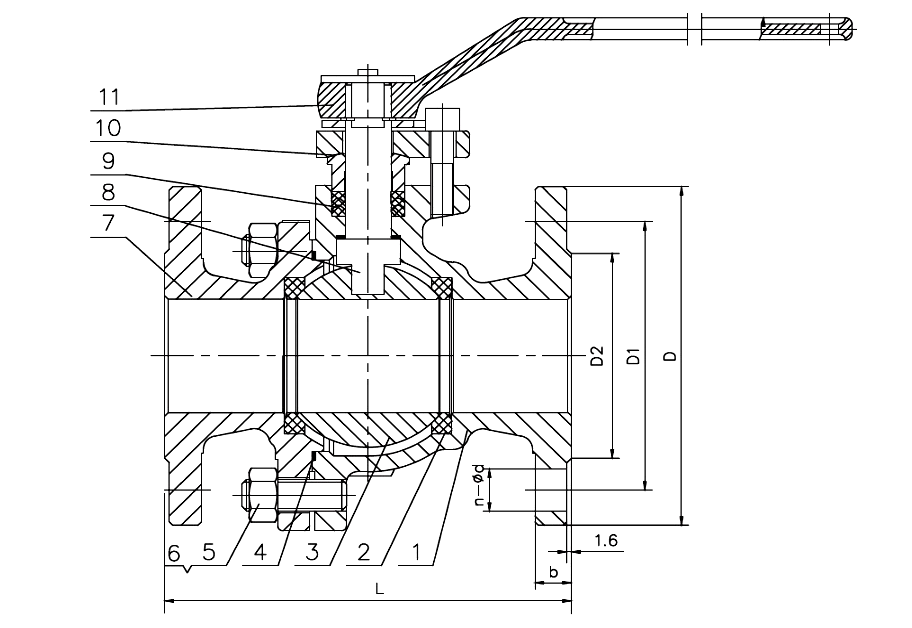
Numbered to match the item numbers below — including the lettered ones (17a, 19a, 19c, 20a). The section shows the bolted body and body connector, the PTFE seats, and the graphite packing stack around the stem.
With the manufacturer's own item numbers.
| No | Part name | Material |
|---|---|---|
| 1 | Body | ASTM A216 WCB |
| 2 | Body Connector | ASTM A216 WCB |
| 3 | Ball | ASTM A240 304 |
| 6 | Stem | ASTM A182 F304 |
| 10 | Packing Gland | ASTM A216 WCB |
| 13 | Seat | PTFE |
| 17a | Gasket | SS304 + graphite |
| 18 | Packing | Flexible graphite |
| 19a | Bolts | ASTM A193 B7 |
| 19c | Screw | ASTM A193 B7 |
| 20a | Nuts | ASTM A194 2H |
| 23 | Thrust Washer | PTFE |
| 24 | Anti-static Device | SS304 |
| 26 | Lever | ASTM A216 WCB + Zn |
| 31 | Stopper | ASTM A29 1025 + Zn |
| 32 | Ring | ASTM A29 1566 |
They are the callout numbers from the sectional drawing — which skip, and some of which carry letters. We have left them exactly as published so a spares order matches the drawing.
The rest is graphite packing and a graphite-faced gasket. That is the biggest material difference from the SS316 variants, which seal on PTFE throughout.
A240 304 ball and A182 F304 stem, inside a carbon steel body. If the fluid calls for 316, this is not the valve.
SS304, fitted as standard — and absent from every SS316 parts list in this range.
Not the graphite, and not the body. Graphite would take far more; the seat is what stops it at 150 °C.
Factory proof tests. Not working pressures.
| Item | Value |
|---|---|
| Nominal pressure | Class 150 |
| Body test | 3.0 MPa |
| Seat test | 2.2 MPa |
| Hermetic sealing test | 0.6 MPa |
| Max working temperature | −29 °C to 150 °C |
They are manufacturing proof tests well above the working rating. The valve is not intended to operate there.
3.0/2.2 MPa against 2.4/1.8 MPa — same class, different figures, because the two families come from different catalogue sources with different test regimes. It does not mean this valve has a higher working rating.
The same cast steel valve at Class 300 states a 100 °C ceiling, not 150. If you are stepping up a class, check that figure — ANSI 300 cast steel.
Flange standard first, then material.
All six, side by side: the comparison table.
Dimensions and part numbers are in the catalogue, as printed; stock and price are not — send the list and we confirm both.
No. The body is cast carbon steel ASTM A216 WCB, and the ball and stem are 304 (A240 and A182 F304), not 316. It is a perfectly good valve for water, air, oil and general non-corrosive service — and it is not a substitute for SS316 where corrosion is the reason stainless was specified. If you need stainless on the same flange, use the ANSI 150 SS316.
Three things. Lower cost. Flexible graphite packing and a graphite-faced gasket, which take more heat than PTFE and behave better under thermal cycling. And stronger bolting: A193 B7 studs with A194 2H nuts are alloy-steel pressure bolting, where the SS316 variants use SS304 fasteners that are more corrosion-resistant but lower strength.
Yes — item 24, SS304, fitted as standard. This is one of only two flange end variants that list one; the four SS316 variants do not. A ball turning on PTFE seats is electrically isolated, and the anti-static device bonds it back to the body. It matters on hydrocarbon duty.
Because the limit is the PTFE seat, not the packing. Graphite would take far more; the seat is what stops it at 150 °C. Note the Class 300 version of the same cast steel valve states a 100 °C ceiling — lower still, as printed.
They are the manufacturer's numbers — the callout numbers from the sectional drawing (17a, 19a, 19c, 20a and so on), not a tidied sequential list. We have left them exactly as published so a spares order matches the drawing.
Because that is how the range is published: 3/4″ to 6″ (DN20 to DN150), nine sizes. If you need 1/2″ on an ANSI 150 flange, use the SS316 variant, which starts there.
Shell 3.0 MPa, seat 2.2 MPa, gas tightness 0.6 MPa. Note those are higher than the Class 150 SS316 variant at 2.4 and 1.8 MPa — same class, different figures, because the two families come from different catalogue sources with different test regimes. It does not mean this valve has a higher working rating.
No. An ANSI 150# flange will not mate with JIS 10K or PN10/16. The bolt circle, hole count and hole diameter all differ. Check the existing flange before ordering.
Held in our Singapore and Malaysia warehouses, out within 24 hours of your PO; quotes within 2 working hours.
Related: all flange end ball valves · ANSI 150 SS316 if you need stainless · flanges · all low pressure valves.