
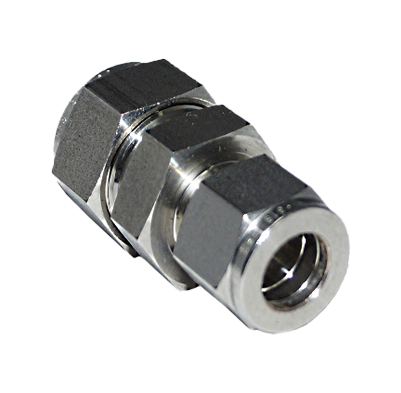
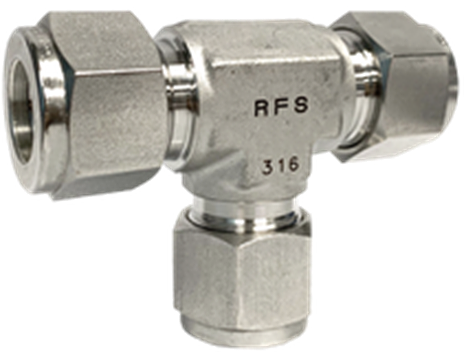
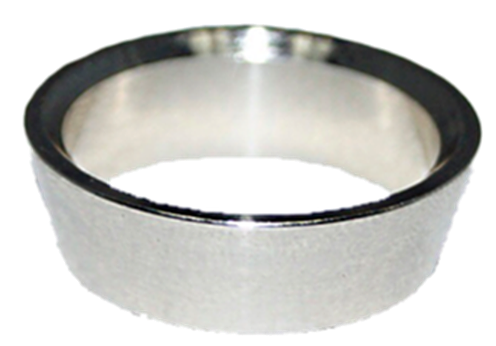

Twin-ferrule instrumentation fittings: the front ferrule seals against the body and the tube OD, the back ferrule rolls forward and grips. For instrumentation, sampling, gas, vacuum and corrosive duty — a joint designed to be broken and remade.
State the tube OD & wall, material, body style and fluid — quotes back within 2 working hours.
| Range | Inch 1/8″–2″ · metric 6–50 mm — not interchangeable |
|---|---|
| Materials | Stainless SS316 · carbon steel · brass |
| Pressure | Set by the tube wall — max 670 bar (6 × 2.5 mm) |
| Body styles | Unions · union tees · female connectors · reducers · weldable bulkheads |
| Matching tube | Seamless SS316 ASTM A269 / A213 |
| Consumables | Front & back ferrules — separate stock items |
Full pressure tables per OD × wall (inch & metric) and the temperature derating are on this page, as printed.
| At a glance | Front ferrule | Back ferrule |
|---|---|---|
| Job | Seals | Grips |
| Against | Body taper & tube OD | The tube — carries axial load |
| On disassembly | Both stay on the tube — keep the pair together | |
Imperial psi · seamless SS316 to A269/A213
| OD | 0.028″ | 0.035″ | 0.049″ | 0.065″ | 0.083″ | 0.095″ | 0.109″ | 0.120″ | 0.134″ | 0.156″ | 0.188″ |
|---|---|---|---|---|---|---|---|---|---|---|---|
| 1/8″ | 8500 | 10900 | — | — | — | — | — | — | — | — | — |
| 3/16″ | 5400 | 7000 | 10200 | — | — | — | — | — | — | — | — |
| 1/4″ | 4000 | 5100 | 7500 | 10200 | — | — | — | — | — | — | — |
| 5/16″ | — | 4000 | 5800 | 8000 | — | — | — | — | — | — | — |
| 3/8″ | — | 3300 | 4800 | 6500 | 8600 | — | — | — | — | — | — |
| 1/2″ | — | 2600 | 3700 | 5100 | 6700 | — | — | — | — | — | — |
| 5/8″ | — | — | 2900 | 4000 | 5200 | 6000 | — | — | — | — | — |
| 3/4″ | — | — | 2400 | 3300 | 4200 | 4900 | 5800 | 6400 | — | — | — |
| 7/8″ | — | — | 2000 | 2800 | 3600 | 4200 | 4800 | 5400 | 6100 | — | — |
| 1″ | — | — | — | 2400 | 3100 | 3600 | 4200 | 4700 | 5300 | 6200 | — |
| 1 1/4″ | — | — | — | — | 2400 | 2800 | 3300 | 3600 | 4100 | 4900 | — |
| 1 1/2″ | — | — | — | — | — | 2300 | 2700 | 3000 | 3400 | 4000 | 4900 |
| 2″ | — | — | — | — | — | — | 2000 | 2200 | 2500 | 2900 | 3600 |
Metric bar · wall in mm · seamless SS316 to A269/A213
| OD | 1.0 | 1.2 | 1.5 | 1.8 | 2.0 | 2.2 | 2.5 | 2.8 | 3.0 | 3.5 | 4.0 | 4.5 | 5.0 |
|---|---|---|---|---|---|---|---|---|---|---|---|---|---|
| 6 | 420 | 520 | 670 | — | — | — | — | — | — | — | — | — | — |
| 8 | 310 | 380 | 490 | — | — | — | — | — | — | — | — | — | — |
| 10 | 240 | 300 | 380 | — | — | — | — | — | — | — | — | — | — |
| 12 | 200 | 240 | 310 | 380 | 430 | — | — | — | — | — | — | — | — |
| 14 | 180 | 220 | 280 | 340 | 390 | 430 | — | — | — | — | — | — | — |
| 15 | 170 | 200 | 260 | 320 | 360 | 400 | — | — | — | — | — | — | — |
| 16 | — | 190 | 240 | 300 | 330 | 370 | — | — | — | — | — | — | — |
| 18 | — | 170 | 210 | 260 | 290 | 320 | 370 | — | — | — | — | — | — |
| 20 | — | 150 | 190 | 230 | 260 | 290 | 330 | 380 | — | — | — | — | — |
| 22 | — | 130 | 170 | 210 | 230 | 260 | 300 | 340 | — | — | — | — | — |
| 25 | — | — | — | 180 | 200 | 230 | 260 | 300 | 320 | — | — | — | — |
| 28 | — | — | — | — | 180 | 200 | 230 | 260 | 280 | 330 | — | — | — |
| 30 | — | — | — | — | 170 | 190 | 210 | 240 | 260 | 310 | — | — | — |
| 32 | — | — | — | — | 160 | 170 | 200 | 230 | 240 | 290 | 330 | — | — |
| 38 | — | — | — | — | — | 140 | 170 | 200 | 230 | 240 | 280 | 310 | — |
| 42 | — | — | — | — | — | — | — | 170 | 180 | 210 | 250 | 280 | — |
| 50 | — | — | — | — | — | — | — | — | 150 | 180 | 200 | 230 | 260 |
Temperature derating multiplier
| Temperature | SS316 | Steel | Brass |
|---|---|---|---|
| to +38 °C | 1.00 | 1.00 | 1.00 |
| +93 °C | 1.00 | 1.00 | 0.88 |
| +149 °C | 1.00 | 0.91 | 0.75 |
| +204 °C | 0.94 | 0.85 | 0.62 |
| +260 °C | 0.88 | 0.80 | 0.13 |
| +316 °C | 0.83 | 0.76 | — |
| +371 °C | 0.80 | 0.71 | — |
| +427 °C | 0.76 | — | — |
| +482 °C | 0.73 | — | — |
| +538 °C | 0.66 | — | — |
| +593 °C | 0.53 | — | — |
| +649 °C | 0.37 | — | — |
Reading the tables: 12 mm × 2 mm SS316 is 430 bar cold; at +260 °C the factor is 0.88, so the joint is 378 bar. Seal limits (where fitted): NBR −25…+110 °C · FKM −28…+204 °C · PTFE −30…+315 °C.
Cut the tube square, deburr inside and out. The tube must bottom on the body shoulder — a back ferrule biting where unsupported is the most common failure.
Until the tube will not turn by hand.
Mark the nut at six o’clock, tighten to nine o’clock — hold the body with a second spanner. Under 1¼ = the front ferrule never seats fully.
Both ferrules stay on the tube. Reinsert into the same body, hand tight until seated, then a light turn — keep the pair together.
Body styles: straight unions · union tees (male/female variants) · female connectors · reducers (quote both sizes) · weldable bulkheads (barrel welded into a panel, ferrule connection each end).
Joints broken frequently for calibration — the main reason the design is specified.
A metal-to-metal seal with no elastomer to permeate or extrude.
Refinery, chemical, petrochemical, pharmaceutical — SS316 as the default.
Onshore, shipbuilding, power generation, semiconductor, vacuum systems.

Dimensions and part numbers are in the catalogues, as printed; stock and price are not — send the list and we confirm both.
A single ferrule does both jobs; a double splits them — the front ferrule seals against the body taper and the tube, the back ferrule grips and carries the axial load. The design has been in industry since 1945 (Parker A-lok and Swagelok among the major names).
Only on 6 mm tube with a 2.5 mm wall. The fitting is rated to whatever the tube it is compressing will carry — see the OD × wall tables above.
Yes — that is one of the reasons it is specified. Both ferrules stay on the tube, already formed to it. Reinsert into the same body, hand tight until seated, then a light turn — not another 1¼ turns.
1¼ turns from finger tight on a first assembly — make sure the tube bottoms on the shoulder first. Mark six o’clock, tighten to nine, hold the body with a second spanner.
Both — inch 1/8″–2″ OD, metric 6–50 mm. Not interchangeable.
SS316 for almost all instrumentation, and anything corrosive, offshore or high temperature. Steel for dry duty; brass for low-pressure air/water (drops above +93 °C).
We would not. There is no dimensional standard behind twin-ferrule fittings — body, nut and both ferrules should come from the same range.
Yes — front and back ferrules are stocked as separate line items. Tell us the size, series and material.
SS316 holds full rated pressure to +149 °C and stays usable, at a reducing factor, to +649 °C. Steel unrated above +371 °C; brass above +260 °C. Seals lower the limits (NBR +110 / FKM +204 / PTFE +315 °C).
Yes — that is one of the main reasons the twin-ferrule design exists. The metal-to-metal seal at the front ferrule has no elastomer to permeate or extrude.
If the tube is seamless stainless to ASTM A269 or A213, in a size and wall on the tables, yes. Welded, unknown-grade or corroded tube needs verifying first.
Yes — in our regional warehouses in Singapore and Malaysia, out within 24 hours of your PO; quotes within 2 working hours.
Related: DIN 2353 compression fittings · JIC fittings · A269 stainless tube · all high pressure fittings · baca halaman ini dalam Bahasa Indonesia