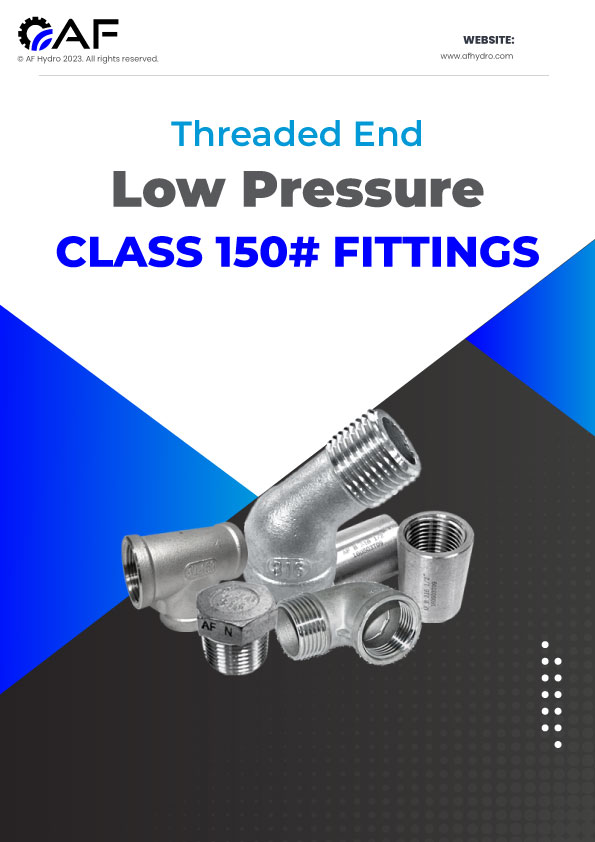
Threaded fittings for low-pressure water, air and utility lines: elbows, tees, couplings, unions, nipples, caps, plugs and bushes — all in SS316 stainless. Used where the pressure is modest and the line has to be openable again.
State shape, size and NPT or BSPT — quotes back within 2 working hours.
| Class | 150 lb (also written 150# or class 150) |
|---|---|
| Range | 1/8″–4″ — DN6 to DN100 |
| Material | SS316 stainless — ASTM A351 CF8M |
| Threads | NPT (60°) or BSPT (55°) — both tapered |
| Sealing | PTFE tape on the male thread |
| Shapes | 13 shapes — see the list on this page |
Dimensions and part numbers per shape are in the AF Hydro catalogue below, as printed.
| At a glance | NPT | BSPT |
|---|---|---|
| Flank angle | 60° | 55° |
| Form | Tapered | Tapered |
| Seal | PTFE tape | PTFE tape |
| Mix them? | You cannot | |
| Shape | What it is for |
|---|---|
| 90° elbow | A square change of direction — the commonest shape on utility lines |
| 45° elbow | A shallow change of direction — less flow restriction than a 90° |
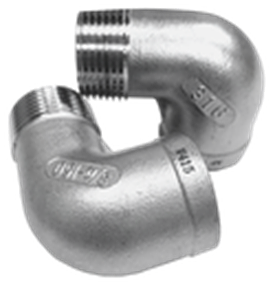
| Street elbow | Male on one end — saves a nipple in a tight joint |
| Tee | A branch; equal tees as standard (all three ends the same size) |
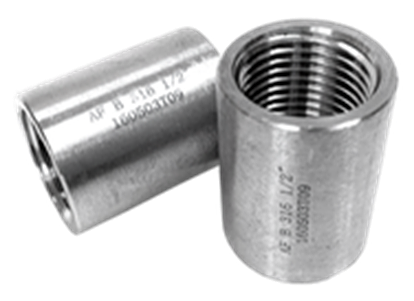
| Full coupling | Joins two pipes permanently, female both ends |
| Reducing coupling | Joins two different pipe sizes |
| Union (F/F) | Conical seat with a loose nut — the line can be broken in place |
| Hex nipple | Male both ends — joins two female-ported components |
| Reducing hex nipple | Male both ends, two different sizes |
| Round cap | Closes a male pipe end |
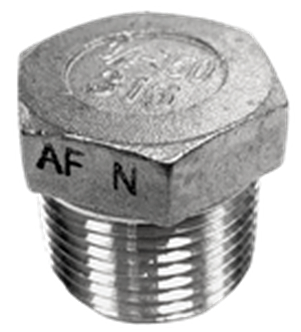
| Hex head plug | Closes a female port — tightened with a hex spanner |
| Square head plug | Closes a female port — square head for higher torque |
| Hex bush | Reduces one port to a smaller size |
Couplings join permanently; unions come apart. If that point will be broken for maintenance, order a union from the start — taking a coupling apart means turning the whole pipe run.
| Material | How it compares |
|---|---|
| SS316 — ASTM A351 CF8M | What we stock. The highest corrosion resistance and durability of the four; the molybdenum in it is what gives chloride resistance. |
| 304 stainless | Lacks the molybdenum — lower chloride resistance. Be careful on seawater or treated-water lines. |
| Brass | Lower corrosion resistance than stainless. |
| Malleable iron | The traditional low-cost choice — lower corrosion resistance. |
If you genuinely need brass or malleable iron on cost grounds or to match an existing run, say so — but for water, air and utility lines in a tropical climate, SS316 is what we recommend and what we stock.
| Feature | NPT | BSPT |
|---|---|---|
| Full name | National Pipe Thread | British Standard Pipe Tapered |
| Flank angle | 60° | 55° |
| Form | Tapered | Tapered |
| How it seals | By wedging on the thread, helped by PTFE tape | |
⚠ The two cannot be used together. The different flank angles mean a mismatched pair will engage a few turns and then leak — and that leak cannot be cured by tightening harder. State NPT or BSPT on your PO.
Wound in the tightening direction, so the tape does not peel as the fitting goes in.
Too much tape stops the thread before it wedges — the joint feels tight without having sealed.
Over-tightening is the most common damage. Tapered threads seal by wedging; excessive force stretches the port.
The fitting must match the pipe size, and the run must be aligned — forcing alignment through the thread produces a joint that leaks later.
Dimensions and part numbers per shape are in the catalogue, as printed; stock and price are not — send the list and we confirm both.
Moderate-pressure cooling water lines that need breaking for maintenance.
SS316 for a salt environment — the molybdenum is what decides it.
Fire lines — threaded joints, no site welding.
Water, instrument air and general utility runs.
Moderate pressure, frequently altered — the strength of threaded fittings.
Non-critical low-pressure runs.
It is a pressure class designation (also written 150# or 150 lb) for low-pressure threaded pipe fittings — used on non-critical lines where low cost and easy reassembly matter.
No. The thread flank angles differ — NPT 60°, BSPT 55°. A mismatched pair engages a few turns and then leaks, and that cannot be cured by tightening harder. State which on the PO.
Corrosion resistance and durability beyond brass or malleable iron. We stock SS316 (ASTM A351 CF8M) — the molybdenum in it gives chloride resistance, and that is what 304 lacks.
Couplings join permanently; unions have conical seats and loose nuts, so the line can be broken in place without turning the pipework. If that point will be opened for maintenance, use a union.
Over-tightening is the most common damage. Tapered threads seal by wedging — excessive force stretches the port, and a stretched port leaks. PTFE tape on the male thread, do not overdo it, tighten until home, then stop.
Yes — threaded low-pressure fittings allow reassembly at any time, without welding. That is the main reason to choose them for utility lines.
Size, class and material are cast into the body — markings like “1/4 – 150” and “316”. Send a photo on WhatsApp and we will match it.
90° and 45° elbows, street elbows, tees (equal tees as standard), full couplings, reducing couplings, F/F unions, hex nipples, reducing hex nipples, round caps, hex and square head plugs, and hex bushes. The full table is on this page.
Yes — we hold this range in our regional warehouses in Singapore and Malaysia, out within 24 hours of your PO; quotes back within 2 working hours.
Related: camlock fittings · forged pipe fittings · pipe adapter fittings · about the AF Hydro brand · all low pressure fittings · baca halaman ini dalam Bahasa Indonesia